

Key Factors to Consider When Choosing Crash Barrier Suppliers Before Procurement
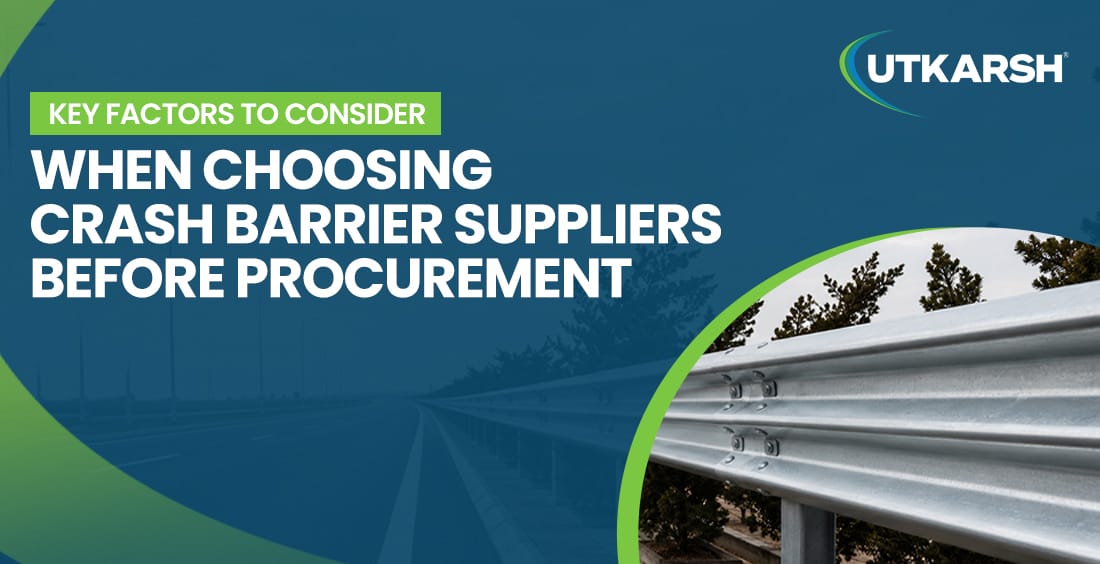
In modern transportation infrastructure, safety is never an afterthought, it is engineered into every kilometre of roadway. Whether it is a national expressway, a mountain pass, a bridge approach, or an industrial logistics corridor, the effectiveness of roadside protection depends heavily on choosing the right crash barrier suppliers.
A poorly selected barrier can compromise vehicle containment, increase maintenance costs, and even fail during critical impact scenarios. On the other hand, partnering with an experienced supplier ensures long-term structural reliability, compliance with safety norms, and dependable performance under real-world conditions.
Before procurement, project consultants, EPC contractors, highway developers, and government authorities must evaluate several technical and commercial factors to ensure they are investing in the right road safety barriers for their project.
This guide explores the key considerations, the major barrier types available in the market, and where each solution performs best.
Why Supplier Selection Matters in Crash Barrier Procurement
A crash barrier is not simply a steel product installed alongside a roadway. It is a tested safety system designed to absorb impact energy, redirect vehicles, and reduce accident severity.
The quality of this system depends on:
- Material consistency
- Structural design
- Crash-test validation
- Installation accuracy
- Compliance with national and international standards
Industry discussions among infrastructure professionals consistently highlight that barrier performance depends not just on beam design but also on post spacing, steel grade, coating thickness, and installation precision.
That is why selecting trusted crash barrier suppliers becomes one of the most critical procurement decisions.
Verify Compliance with Industry Standards
The first factor to examine is certification and compliance. Reliable suppliers should manufacture products that comply with recognised road safety standards.
Key standards include:
- IRC 119 for Indian road restraint systems
- MoRTH Clause 810 for highway safety installations
- EN 1317 for crash performance evaluation
- AASHTO M180 for metal beam guardrails
Crash barriers that conform to the standards undergo impact testing for containment, deformation, occupant safety, and redirection performance.
Utkarsh India's crash barrier systems are manufactured in accordance with IRC and EN safety requirements, ensuring dependable performance across highway and bridge projects.
Evaluate Manufacturing Capability
Not every supplier is a manufacturer. Many vendors act as traders or intermediaries.
Before procurement, verify whether the supplier has:
1. In-House Roll Forming and Fabrication
Suppliers with advanced manufacturing lines ensure dimensional accuracy and consistent production quality.
2. Large Production Capacity
For large highway projects, uninterrupted supply is essential. Production capability directly affects project timelines.
3. In-House Testing Facilities
Testing capabilities demonstrate engineering maturity and quality control discipline.
Utkarsh India maintains large-scale in-house production and ready stock availability for infrastructure-scale deployments.
Examine Raw Material Quality
The durability of highway crash barriers begins with steel quality.
Ask suppliers about
- Material Traceability: Every batch should be traceable back to certified mills.
- Dimensional Precision: Uniform thickness ensures predictable crash performance.
Utkarsh India's systems use structural steel conforming to IS standards with engineered dimensional precision.
Review Crash-Test Credentials
A crash barrier is only as reliable as its test validation.
Ask suppliers for
- Full-Scale Crash Test Reports: These reports validate real-world performance.
- Testing Facility Credentials: Recognised facilities such as NATRAX add credibility.
- Vehicle Categories Tested: Barriers should demonstrate containment for passenger cars as well as heavy vehicles.
Utkarsh India's systems have undergone crash testing at NATRAX under EN 1317 protocols.
Understanding Metal Beam Crash Barrier Specifications
When evaluating suppliers, always study the metal beam crash barrier specifications carefully. Understanding how barrier design directly improves passenger protection during collisions, read our guide on the benefits of metal beam crash barriers on vehicle occupants.
Important parameters include
- Beam Thickness: Typical ranges include 2.5 mm to 3.0 mm depending on containment level.
- Post Dimensions: Post geometry affects anchorage strength and impact distribution.
- Centre-to-Centre Spacing: Improper spacing can compromise crash performance.
- Containment Class: H1, H2, W3, W4, and W5 classifications determine impact performance.
- Working Width: Defines the deflection of barrier, which should be decided based on site condition.
Utkarsh barrier systems are available in multiple containment classes with engineered beam dimensions and tested post configurations.
Evaluate Installation Support
Even the best barrier can fail if installed incorrectly.
Choose suppliers that offer
- Installation manuals
- Site supervision
- Post-installation inspection support
This ensures the barrier performs exactly as it was designed during crash conditions.
Review Project Experience
A supplier's project portfolio reveals their ability to handle infrastructure-scale demands.
Look for experience in:
- National highway projects
- Expressway developments
- Bridge safety systems
- Industrial infrastructure
- Government road modernisation projects
Established suppliers with proven deployment histories reduce procurement risk.
Consider Supply Chain Reliability
Procurement delays can disrupt construction schedules and inflate project costs.
Reliable suppliers should offer:
- Ready inventory
- Pan-India dispatch capability
- Packaging for transit protection
- On-time documentation support
Utkarsh India maintains substantial ready stock to support large-scale project delivery schedules.
Why Utkarsh India is a Trusted Choice for Crash Barrier Procurement
When selecting among leading crash barrier suppliers, experience, engineering precision, and compliance matter.
With crash-tested systems, in-house manufacturing, high-grade galvanised steel, and adherence to global safety standards, Utkarsh India delivers dependable highway crash barriers for highways, bridges, industrial zones, and smart infrastructure projects across India.
Also Read: Highway Safety in India: Key Challenges and Infrastructure Solutions
Final Thoughts
Choosing the right crash barrier suppliers goes far beyond pricing. The real value lies in engineering integrity, tested performance, corrosion resistance, installation support, and long-term reliability.
Whether your project requires W beam systems for standard highways or Thrie beam systems for high-risk infrastructure, working with an experienced manufacturer ensures every kilometre is built with safety at its core.
With proven manufacturing expertise, crash-tested designs, and compliance-driven engineering, Utkarsh India continues to support safer roads across India.
FAQs
What should I check before selecting crash barrier suppliers?
You should verify certifications, crash-test reports, manufacturing capability, steel quality, galvanisation standards, installation support, and project experience.
Which barrier is better, W beam or Thrie beam?
W beam barriers are ideal for standard highways and urban roads, while Thrie beam barriers offer higher containment and are better suited for bridges, sharp curves, and high-speed corridors.
Are crash barriers mandatory on highways?
Yes, highways with embankments, medians, bridges, curves, or accident-prone zones typically require crash barriers as per roadway safety guidelines.
How long do galvanised crash barriers last?
High-quality galvanised barriers can deliver decades of service, depending on environmental exposure and maintenance practices.
Why are metal beam crash barrier specifications important?
Specifications determine structural strength, impact absorption, vehicle redirection capability, and compliance with safety standards.