

How ERW Steel Pipes Are Tested Before Dispatch
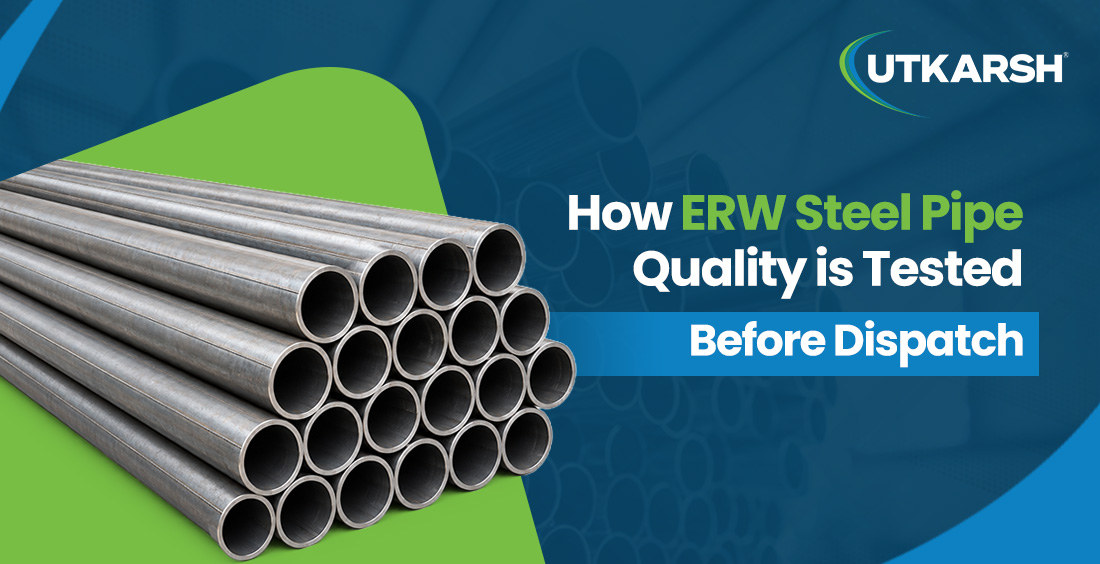
ERW steel pipes are used across construction frameworks, firefighting systems, water supply networks, HVAC lines, scaffolding, industrial plants, automobiles and conveyor idlers. In each of these applications, the pipe is expected to carry loads, hold pressure or resist corrosion for years without failure.
Because ERW pipes are formed from steel coil and joined along a longitudinal weld seam, their performance depends heavily on raw material quality, weld integrity and dimensional accuracy. That is why reliable manufacturers test every batch at multiple stages, not just at the end of the line.
This article explains the key stages of ERW pipe quality testing, what each test checks and why it matters before a pipe is cleared for dispatch.
Why ERW Pipe Quality Testing Matters
The weld seam is the most critical part of any ERW pipe. A small defect that goes unnoticed in the factory can lead to leaks in a water line, weak joints in a structural frame or failure in a fire hydrant system under pressure.
Thorough testing helps manufacturers:
- Confirm the steel meets the required chemical and mechanical properties
- Detect weld defects before they reach the site
- Ensure pipes can withstand the pressure they are designed for
- Maintain dimensional accuracy for proper fit and fabrication
- Verify coating quality for long-term corrosion resistance
Stage 1: Raw Material Verification
Good ERW pipe quality begins with good steel. At Utkarsh India, hot-rolled (HR) coils are sourced from leading steel producers such as SAIL and TATA.
Before production, the material is checked for chemical composition using an in-house spectrometer laboratory. This confirms that elements such as carbon, manganese, sulphur and phosphorus are within the limits required by the applicable standard. Mechanical properties are also assessed to make sure the steel has the strength and ductility needed for forming and welding.
Coils are then slit to the required width on dedicated slitting lines, ensuring uniform strip dimensions for consistent forming.
Stage 2: Online Eddy Current Testing During ERW Pipe Manufacturing
ERW pipe manufacturing at Utkarsh India runs on six high-speed tube mills with speeds of up to 100 metres per minute. At this pace, weld quality has to be monitored continuously, not just sampled.
Online non-destructive testing (NDT) using eddy current testing checks the weld seam while the pipe is still on the mill. An electromagnetic field is passed around the pipe, and any crack, pinhole or lack of fusion in the weld disturbs the field and triggers an alert. Defective sections can then be marked and removed before they move further down the line.
Also Read: Utkarsh India ERW Pipe Manufacturing Process: Quality Coil to Pipe
Stage 3: Hydrostatic Pressure Testing
Hydro testing confirms that the pipe is leakproof. Each pipe is filled with water and pressurised to a specified level, then held to check for leaks, sweating or deformation along the body and weld.
Every ERW pipe produced by Utkarsh India undergoes hydro testing at 5 MPa (50 bar) to ensure complete leakproofness. This is especially important for pipes used in water supply, firefighting systems and fluid transport, where even a minor leak can cause pressure loss or system failure.
Stage 4: Mechanical Testing
Mechanical tests confirm that the finished pipe, including its weld, performs as required under stress. Depending on the applicable standard, these typically include:
- Tensile testing to measure the strength of the pipe material
- Flattening testing to check that the weld does not crack when the pipe is pressed flat
- Bend testing to confirm ductility and weld integrity under bending
Samples are drawn from production batches and tested in-house to verify that strength and weld quality meet specification.
Stage 5: Galvanising Quality Checks
For galvanised or zinc-coated ERW steel pipes, the coating itself must be tested. Utkarsh India uses a 7-tank hot-dip galvanising process with premium zinc, supported by an in-house flux filtering plant that ensures zero iron content in the flux for a cleaner, more uniform coating.
Galvanised pipes are checked for:
- Mass of zinc to confirm adequate coating weight
- Uniformity to ensure even coverage along the pipe
- Adhesion to make sure the coating bonds firmly to the steel
These checks ensure that the pipe resists corrosion in humid, outdoor and underground conditions.
Stage 6: Dimensional and Visual Inspection
Before dispatch, every batch goes through a final inspection to confirm it matches the order specification. This includes checks on:
- Outside diameter or section size
- Wall thickness, within the 2 mm to 10 mm range offered
- Length, with exact lengths supplied to a tolerance of +6 mm
- Straightness and squareness of ends
- End conditions, such as plain, threaded or customised ends
- Surface finish, free from dents, cracks or visible defects
Only pipes that pass this final inspection are cleared for packing and dispatch.
ERW Pipe Quality Testing at a Glance
| Test | What It Checks | Why It Matters |
|---|---|---|
| Spectrometer analysis | Chemical composition of steel | Ensures weldability and strength |
| Eddy current testing | Weld seam defects during production | Catches cracks and pinholes early |
| Hydrostatic test | Leakproofness at 50 bar | Confirms pressure-holding capacity |
| Mechanical tests | Strength, ductility and weld integrity | Ensures performance under load |
| Galvanising tests | Zinc mass, uniformity and adhesion | Ensures long-term corrosion resistance |
| Final inspection | Dimensions, ends and surface finish | Ensures correct fit on site |
Standards and Certifications
ERW hollow sections at Utkarsh India are manufactured in accordance with IS 4923:1997, and the company holds BIS licences for multiple Indian Standards, including IS 1239, IS 1161, IS 3589 and IS 4923. Products also align with ASTM and BS standards where required.
Utkarsh India's ERW products have received approvals and certifications from organisations including BHEL, PHE, PWD, SGS, CE, DNV, BVQI and TUV.
Also Read: Difference between MS and ERW pipes
Tested at Every Stage, Trusted on Every Project
Quality in ERW steel pipes is built at every stage, from raw material checks and eddy current testing to hydro tests, coating checks and final inspection. Together, these steps ensure each pipe holds pressure, carries load and resists corrosion as intended.
With over 40 years of experience, Utkarsh India has supplied ERW pipes for projects such as the Jal Jeevan Mission (all over India), NTPC, PGCIL, IOCL, BPCL, PCL, HPCL and HAL. Its 6 high-speed tube mills, in-house testing facility, BIS licences and approvals from SGS, DNV and TUV reflect proven expertise and industry trust. Every pipe passes each quality check before dispatch, so you can rely on Utkarsh India's ERW steel pipes and ERW hollow sections from day one. Contact our team to discuss your requirements.
FAQs
1. How are ERW steel pipes tested for quality?
ERW steel pipes are tested through raw material analysis, online eddy current testing of the weld, hydrostatic pressure testing, mechanical tests, galvanising checks and final dimensional inspection.
2. What is eddy current testing in ERW pipes?
Eddy current testing is a non-destructive method that uses an electromagnetic field to detect cracks, pinholes or lack of fusion in the weld seam while the pipe is being produced.
3. At what pressure are Utkarsh India ERW pipes hydro tested?
Every ERW pipe from Utkarsh India is hydro tested at 5 MPa (50 bar) to ensure complete leakproofness.
4. Which standards do Utkarsh India ERW pipes follow?
Utkarsh India's ERW hollow sections are made as per IS 4923:1997, and the company holds BIS licences for IS 1239, IS 1161, IS 3589, IS 4923, IS 4270, IS 9295 and IS 3601, with alignment to ASTM and BS standards where required.