

PEB Shed vs Conventional Steel Shed: Which is Better?
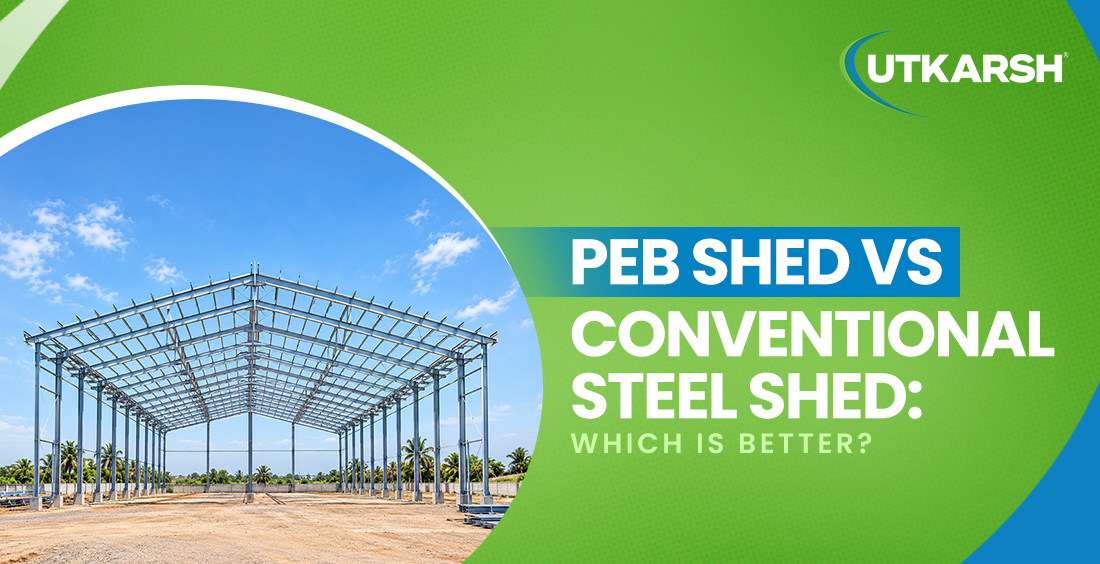
Choosing between a PEB shed and a conventional steel shed is one of the earliest and most important decisions in any industrial shed construction project. Both use structural steel, but they differ in how the structure is designed, fabricated and erected. A PEB shed is engineered for the exact loads of a project, fabricated in a factory and bolted together at site. A conventional steel shed relies on standard hot-rolled sections that are cut, welded and assembled largely on site.
These differences directly affect construction speed, steel consumption, usable floor space, quality control and the ease of future expansion. However, no single system is ideal for every project. The right choice depends on what the shed will be used for, the loads it must carry and how quickly it needs to be operational.
Quick Answer: A PEB shed is the better choice for most warehouses, factories, cold storage units and agricultural sheds. It is faster to build, uses steel more efficiently, offers column-free space and is easier to expand. A conventional steel shed still makes sense for small, irregular or access-restricted sites.
This guide compares both systems across six common applications, looks at durability, corrosion and fire performance, and ends with a side-by-side scorecard to help you decide which one suits your requirements.
Warehouses and Logistics Hubs
What the space demands: Maximum floor area, high stacking, smooth forklift and truck movement, and a fast start to operations.
PEB shed: Clear-span frames remove the need for intermediate columns. That frees up more room for racking, allows wider aisles and makes loading and unloading faster.
Conventional steel shed: Wider spans need heavier trusses or extra columns, which eat into storage area and slow down material handling.
Verdict: PEB shed. In a warehouse, every column removed adds usable storage space, and a shorter build means operations can start sooner.
Manufacturing Plants with Cranes
Crane-served plants need frames strong enough to carry EOT cranes, room for heavy machinery and the flexibility to add production lines later.
PEB shed: Crane beams and frames are designed around the exact crane capacity, so load paths are accurate and steel is placed only where it is needed. The result is a safe, efficient plant that does not carry unnecessary weight.
Conventional steel shed: It can carry crane loads, but standard rolled sections are often oversized, and site welding of crane girders demands high skill and close supervision.
Verdict: PEB shed. Utkarsh India's PEB facility for SAT Metals in Jamshedpur shows how large industrial plants can be delivered within a planned six-month timeline.
Also Read: Which Industries Benefit the Most from PEB Structures?
Cold Storage and Food Processing Units
What the space demands: Tight, well-sealed building envelopes, insulated panels, controlled temperatures and hygiene-friendly interiors.
PEB shed: Factory-made components arrive with precise dimensions, giving insulated roof and wall panels a true, consistent surface to fit against. Paired with a good panel system and careful joint detailing, this helps reduce air leakage and energy loss.
Conventional steel shed: Site-cut and site-welded members can carry small dimensional variations, so panel installation often needs more on-site adjustment to achieve a tight seal.
Verdict: PEB shed. Envelope performance depends mainly on the panel system and how joints are detailed, but a precise frame makes that work easier to get right.
Workshops and Fabrication Units
For a workshop, the priority is a sturdy shell that goes up quickly, with good natural light, ventilation and room to grow as orders increase.
PEB shed: Bolted connections and pre-planned end-wall extensions allow new bays to be added without demolishing any existing structure, so capacity can increase in step with demand.
Conventional steel shed: Expansion usually means cutting into welded joints, reworking trusses and halting work while modifications happen.
Verdict: PEB shed for most growing units. For a very small workshop with no plans to expand, a conventional shed can still do the job.
Also Read: Cost-Saving Tips for PEB Building Industrial Sheds
Agricultural Sheds and Rural Storage
What the space demands: Durable covered space for grain, equipment or processing, often at sites with limited skilled labour.
PEB shed: Components arrive pre-fabricated and numbered, and the superstructure is erected with bolted, dry connections. Only the foundations need concrete work, so a smaller crew can complete erection faster. This makes PEB a practical solution even in remote locations.
Conventional steel shed: It relies on local fabricators, so quality and timelines depend heavily on who is available on the ground.
Verdict: PEB shed, especially where skilled site labour is hard to find.
Small, Irregular or One-Off Sheds
Some projects call for a compact footprint, an unusual shape or a cramped site where long components are difficult to deliver.
PEB shed: Fully capable, but the engineering advantage is smaller when the structure is tiny or highly irregular.
Conventional steel shed: A local fabricator can cut and weld to suit odd angles and cramped sites without transporting long members.
Verdict: A conventional steel shed can be the sensible choice here. This is where it still holds its ground.
Durability, Corrosion Protection and Fire Performance
Design Life and Maintenance
Both systems are built from structural steel, so service life depends more on design quality, coatings and maintenance than on the system itself. A well-designed and well-maintained shed of either type can serve for decades. PEB sheds have fewer site welds and factory-applied coatings, which keeps coating quality more consistent and makes routine inspections simpler. Typical upkeep for both includes checking bolt tightness, touching up damaged coatings, inspecting roof sheeting fasteners and keeping gutters clear.
Corrosion Protection
PEB members can be hot-dip galvanised or coated with a specified paint system inside the factory, where surface preparation, coating thickness and curing are controlled. Conventional sheds are often painted on site after welding, where dust, humidity and weather affect coating quality, and welded joints tend to become early corrosion points. For sheds in coastal, chemical or high-humidity environments, factory galvanising offers a clear advantage.
Fire Performance
Steel does not burn, but it loses strength at high temperatures, and this applies to both systems equally. Neither has an inherent fire advantage. PEB frames use thinner, tapered sections that can heat up faster, so fire safety should be planned at the design stage. Measures such as intumescent coatings, fire-rated wall panels and proper compartmentation can be specified as required by the National Building Code of India and the local fire authority.
PEB Shed vs Conventional Steel Shed: The Scorecard
| Criteria | PEB Shed | Conventional Steel Shed |
|---|---|---|
| Construction speed | Faster, as fabrication runs parallel to foundation work | Slower, as each stage follows the last |
| Typical project timeline | Around 8 to 16 weeks for a standard industrial shed, depending on size and approvals | Often 1.5 to 2 times longer for a comparable shed |
| Steel efficiency | Tapered sections use steel only where needed | Standard sections often oversized |
| Clear-span space | Large column-free interiors | Wider spans need heavier trusses or columns |
| Quality control | Factory-made and inspected | Depends on site skill and weather |
| Corrosion protection | Factory galvanising or controlled paint systems | Site painting after welding; joints are vulnerable |
| Design life and maintenance | Decades of service with simpler inspections | Decades of service, but welded joints need closer checks |
| Fire performance | Similar to conventional; thinner sections need planned fire protection | Similar to PEB; protection needed as per code |
| Future expansion | Add bays with minimal disruption | Complex and disruptive |
| Relocation | Can be dismantled and reassembled | Difficult due to welded joints |
| Site impact | Dry, clean and low waste | More scrap, noise and site activity |
| Best fit | Warehouses, factories, cold storage, logistics, agri sheds | Small, irregular or access-restricted sheds |
The bottom line: For most industrial, commercial and agricultural projects, a PEB structure wins on speed, efficiency and flexibility. A conventional steel shed remains a fair option only for small or unusual builds.
Also Read: What are Pre-Engineered Buildings, and How do They Differ from Conventional Construction?
Build Your PEB Shed with Utkarsh India
The right structure needs the right manufacturer behind it. Utkarsh India brings:
- 40+ years in steel fabrication, with PEB projects for SAT Metals, Celebrity Breweries, Shakambari Enterprise and more.
- An in-house engineering team designing every PEB structure to IS 800:2007, IS 875 (Parts 1 to 3, including Part 3 for wind loads), IS 1893 (Part 1):2016, AISC and MBMA standards.
- 25,000 MT monthly steel fabrication capacity and a client base that includes L&T, Tata Projects, NTPC and Indian Railways.
- ISO 9001:2015 certification, with in-house fabrication, galvanising, testing and installation under one roof.
Planning your next shed? Talk to our PEB team for a structure built around your application.
FAQs
1. Is a PEB shed better than a conventional steel shed?
For most warehouses, factories, cold storage units and agricultural sheds, yes. A PEB shed offers faster construction, efficient steel use, column-free space and easy expansion. Conventional sheds suit small or irregular structures.
2. Is a PEB shed cheaper than a conventional steel shed?
For medium and large sheds, a PEB shed usually costs less over the full project. Tapered sections reduce steel tonnage and often foundation loads, and a shorter build cuts labour and site overheads. For very small or irregular sheds, a local fabricator building a conventional shed can sometimes be cheaper. Compare complete quotes, including foundations, erection and timeline, rather than steel price alone.
3. How long does a PEB shed take to build?
A standard industrial PEB shed typically takes around 8 to 16 weeks from design approval to handover, because fabrication runs alongside foundation work. Large plants with cranes take longer. Utkarsh India's PEB facility for SAT Metals in Jamshedpur was delivered within a planned six-month timeline.
4. What is the lifespan of a PEB shed?
A PEB shed is commonly designed for a service life of 50 years or more. Actual life depends on the coating system, the site environment and maintenance. Galvanised or well-coated members, periodic bolt checks and timely coating touch-ups help the structure last.
5. Can a PEB shed handle heavy cranes and machinery?
Yes. A PEB shed can be designed with crane beams and frames engineered for the exact crane capacity and machinery loads of your plant.
6. Is a PEB shed suitable for cold storage?
Yes. Precisely fabricated components give insulated panels a consistent surface to fit against, which, combined with good joint detailing, helps maintain stable temperatures and reduce energy loss.
7. Can I expand my PEB shed later?
Yes. A PEB shed can be extended by adding bays at the end walls, with minimal disruption to ongoing operations, especially if expansion is planned at the design stage.
8. When should I choose a conventional steel shed?
Choose a conventional steel shed when the structure is small, has an irregular shape, sits on a site where long components are hard to deliver, or will never need expansion. In these cases, the speed and engineering advantages of PEB matter less.