

Understanding the Role of GI and Steel Sections in Solar Rooftop Structures
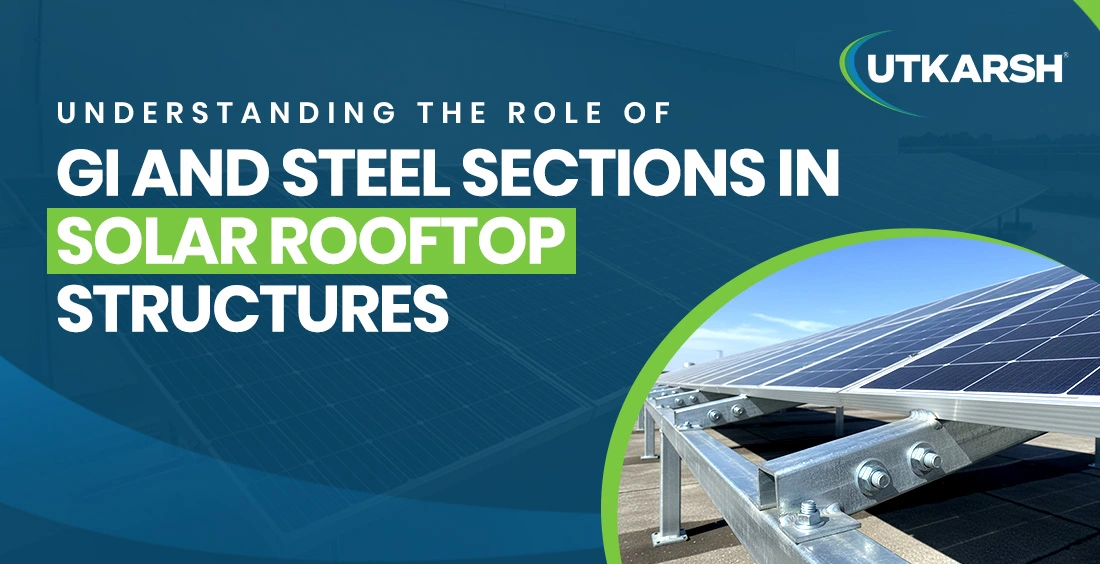
India's renewable energy expansion has made every solar rooftop structure a long-term infrastructure investment not just a mounting frame. Project owners agree on one critical fact performance and durability depend heavily on the structural system beneath the panels.
This article promises to give you a deeper technical understanding of how GI sections for solar mounting and steel sections in solar structures determine strength, corrosion resistance, life cycle cost, and safety.
We will examine structural engineering considerations, galvanisation science, material selection criteria, and how Utkarsh India's in-house GI facilities and 7 tank process elevate the reliability of modern solar mounting structures.
Why Structural Engineering Matters in Solar Rooftop Systems
A solar rooftop structure is not merely a support frame it is a load-distribution system designed to:
- Transfer dead load of modules safely to the building
- Resist uplift forces caused by high wind speeds
- Maintain tilt stability for optimal energy generation
- Withstand corrosion over 25+ years
- Minimise roof penetration and maintenance
The structural material selected, particularly GI sections for solar mounting and engineered steel sections in solar structures, directly impacts system lifespan and ROI.
Understanding GI Sections for Solar Mounting
What Makes GI Essential?
Galvanised Iron (GI) sections are steel members coated with zinc to protect against corrosion. In outdoor installations, corrosion is the single largest threat to structural longevity.
Key Engineering Advantages
Long-Term Corrosion Protection
Zinc coating forms a protective barrier and sacrificial layer, ensuring the base steel remains intact even in coastal or high-humidity environments.
Lower Maintenance Costs
Well-galvanised solar mounting structures reduce repainting, rust repair, and structural replacement.
Uniform Structural Performance
High-quality galvanisation prevents localised rust pockets that weaken joints and fasteners.
Lifecycle Efficiency
A properly coated solar rooftop structure can match or exceed the 25-year lifecycle of solar modules.
Also Read: Key Design Parameters for Rooftop Solar Mounting Structure Systems
The Structural Importance of Steel Sections in Solar Structures
While GI protects against corrosion, the backbone strength comes from steel sections in solar structures.
Types Commonly Used
- C Channels
- Z Sections
- Angles
- RHS & SHS Tubular Sections
- Custom Roll-Formed Profiles
Why Steel is Indispensable
1. High Load-Bearing Capacity
Steel distributes module weight evenly across rooftops.
2. Wind Uplift Resistance
Properly engineered steel sections prevent panel detachment in high wind zones.
3. Seismic Stability
In earthquake-prone regions, structural flexibility and strength are crucial.
4. Design Customisation
Steel allows fabrication flexibility for industrial, commercial, and residential solar mounting structures.
Science Behind Galvanisation: Why Process Matters
Not all galvanisation delivers the same performance. Poor coating thickness, uneven dipping, or inadequate pre-treatment can result in:
- Early rusting
- Flaking of zinc layer
- Structural weakening
- Reduced asset life
For long-term performance of solar mounting structures, controlled galvanisation is critical.
Utkarsh India: Engineering Reliable Solar Rooftop Structure Systems
Advanced In-House GI Facilities
Utkarsh India integrates structural manufacturing with in-house galvanisation capabilities ensuring complete quality control for every solar rooftop structure component.
7 Tank Galvanising Process
Utkarsh India follows a scientifically managed 7 tank process:
- Degreasing
- Rinsing
- Pickling
- Rinsing
- Fluxing
- Hot-dip galvanising (molten zinc bath)
- Passivation
This controlled sequence ensures:
- Superior zinc adhesion
- Uniform coating thickness
- Enhanced corrosion resistance
- Extended lifespan of GI sections for solar mounting
Why Utkarsh India Stands Out
Utkarsh India leverages deep structural engineering knowledge in manufacturing precision steel sections in solar structures and customised solar mounting structures. With forty years of involvement in infrastructure-grade manufacturing, Utkarsh understands regional wind loads, corrosion zones, and rooftop challenges across India. Integrated production, in-house GI facilities, and adherence to stringent quality benchmarks position Utkarsh as a trusted structural partner. Understanding the solar mounting structure types widely used in India's solar sector helps developers choose the right configuration for durability, efficiency, and long-term performance.
The 7 tank galvanising process ensures consistent, measurable corrosion protection enhancing reliability of every solar rooftop structure delivered. By combining structural strength with advanced galvanisation, Utkarsh India delivers long-lasting, high-performance solar mounting structures designed for demanding environments.
Applications of GI & Steel Solar Rooftop Structures
- Industrial plants
- Warehouses
- Commercial buildings
- Institutional campuses
- Hospitals
- Government facilities
- Residential complexes
Each project demands different GI sections for solar mounting and engineered steel sections in solar structures to meet structural and environmental requirements.
Conclusion
The performance of a solar rooftop structure depends not just on panel technology, but on the structural system supporting it. High-quality GI sections for solar mounting protect against corrosion, while robust steel sections in solar structures provide essential strength and stability.
Through advanced in-house GI facilities and a precise 7 tank galvanisation process, Utkarsh India ensures that its solar mounting structures deliver durability, safety, and long-term value.
Strong structure. Sustainable power. Reliable performance.
FAQs
1. What is the lifespan of a solar rooftop structure?
A well-engineered solar rooftop structure with quality GI coating can last 25-30 years.
2. Why are GI sections preferred in solar mounting structures?
GI sections for solar mounting provide corrosion resistance and reduce long-term maintenance costs.
3. How do steel sections enhance solar structure durability?
Steel sections in solar structures improve load-bearing capacity, wind resistance, and structural integrity.
4. What is the benefit of a 7 tank galvanising process?
It ensures better surface preparation, uniform zinc coating, and enhanced corrosion protection.
5. Can solar mounting structures be customised?
Yes, solar mounting structures are engineered based on roof type, wind load, and environmental conditions.
6. Why is in-house galvanisation important?
In-house GI facilities allow strict quality control, consistent coating thickness, and improved durability.