

The Role of High Lighting Mast Poles in Large Infrastructure Projects
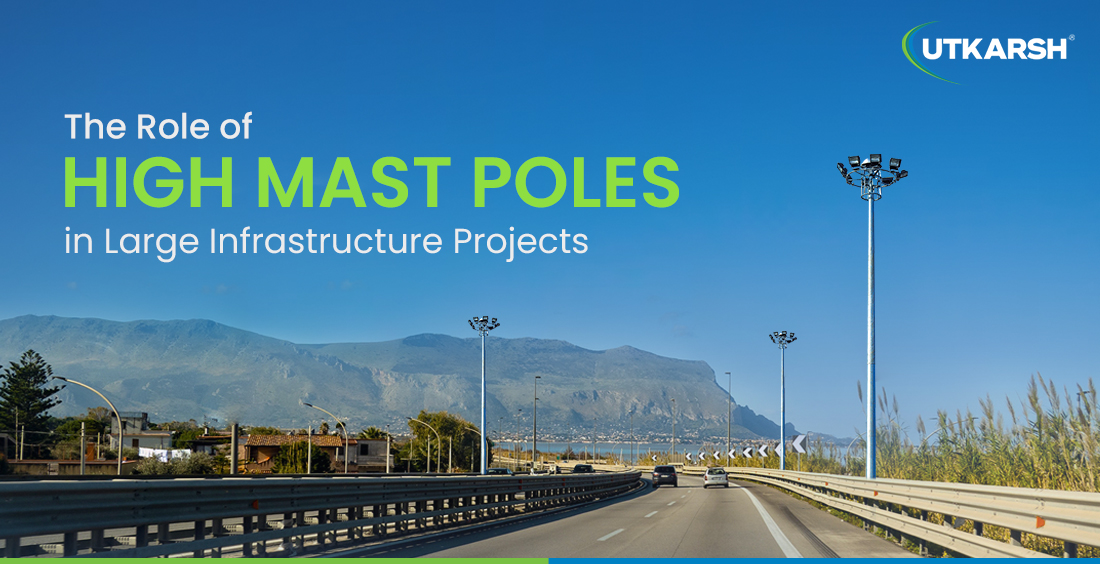
Large infrastructure projects such as highways, airports, ports, railway yards, industrial facilities, and large parking areas require lighting systems that can cover extensive spaces efficiently. Poorly planned lighting can create dark spots, reduce visibility, and affect the safe movement of vehicles, equipment, and people.
A high mast light pole provides a practical solution for illuminating large open areas from an elevated position. By mounting multiple lighting fixtures at a considerable height, a high mast lighting system can provide broad and relatively uniform illumination while reducing the number of poles required across a site.
With their wide-area coverage, structural strength, and application flexibility, high mast poles have become an important part of modern infrastructure lighting.
1. Efficient Lighting for Wide-Area Coverage
One of the main advantages of a high mast lighting system is its ability to illuminate a large area from a limited number of locations.
Conventional low-height lighting may require multiple poles to provide adequate illumination across a large site. This can increase the number of foundations, electrical connections, and maintenance points.
High mast poles position multiple luminaires at a greater height, allowing light to cover a wider area. This makes them suitable for applications such as:
- Highways and expressways
- Toll plazas
- Airports and aircraft parking areas
- Railway yards
- Ports and container terminals
- Large parking areas
- Industrial complexes
- Sports grounds
- Construction sites
The final number, height, and arrangement of poles should be determined through an appropriate lighting design based on the site's dimensions, required illumination levels, fixture characteristics, and applicable standards.
2. Better Visibility for Large Infrastructure Areas
Visibility is an important consideration wherever vehicles, heavy equipment, workers, and pedestrians operate after dark.
A properly designed high mast lighting installation can provide illumination across large areas and help reduce poorly lit zones. This can support safer movement and improve visibility for drivers, operators, workers, and security personnel.
For example, highways and toll plazas experience continuous vehicle movement, while ports and industrial facilities may operate around the clock. Adequate lighting allows these activities to continue with better visibility during night-time operations.
High mast lighting can also help illuminate access roads, storage areas, loading zones, and other large outdoor spaces that may be difficult to cover efficiently using conventional lighting arrangements.
3. Improved Security and Site Monitoring
Large infrastructure facilities often contain valuable equipment, vehicles, cargo, machinery, and materials. Good lighting can support security operations by improving visibility across open areas.
High mast poles can be used to illuminate locations such as:
- Railway yards
- Container terminals
- Airport areas
- Industrial premises
- Large parking facilities
- Warehouses and logistics yards
- Construction sites
Consistent lighting can make it easier for security personnel and surveillance systems to monitor large areas. It can also reduce poorly illuminated sections of a site where unauthorised activity may otherwise be harder to detect.
Lighting is therefore an important part of an integrated security strategy, although it works alongside measures such as CCTV, access control, fencing, and security personnel.
4. Strong and Weather-Resistant Construction
High mast poles are installed outdoors and need to withstand environmental conditions throughout their service life. Their structural design therefore needs to account for factors such as wind loads, pole height, fixture loads, and site-specific conditions.
Galvanised steel is commonly used for high mast poles because galvanisation provides a protective zinc coating that helps protect the underlying steel against corrosion.
A properly designed and manufactured pole can provide reliable structural performance under the environmental conditions considered during its design. This is particularly important for installations located in areas exposed to strong winds, heavy rainfall, coastal conditions, or other challenging environments.
Regular inspection and maintenance are still important to ensure the continued performance of the pole, foundation, electrical components, and lighting fixtures.
5. Flexible Designs for Different Applications
Every infrastructure project has different lighting requirements. A highway interchange may need a different lighting arrangement from an airport, railway yard, or industrial facility.
High mast poles can be manufactured in different heights and configurations according to the requirements of the project. The number and arrangement of lighting fixtures can also be selected according to the required lighting coverage.
Depending on the application, a high mast installation can incorporate suitable components such as:
- Multiple lighting fixtures
- Lantern carriages
- Raising and lowering systems
- Foundation bolts
- Electrical components
- Brackets and accessories
This flexibility allows the lighting system to be designed around the site's layout, required coverage, maintenance approach, and operating conditions.
6. Easier Maintenance with Appropriate Mast Systems
Maintenance is an important consideration for lighting systems installed at significant heights. Accessing individual fixtures on a conventional tall pole can require specialised equipment such as elevated platforms or maintenance vehicles.
Many high mast systems use a raising and lowering mechanism that allows the lantern carriage to be brought down to a more accessible height for inspection, maintenance, and fixture replacement.
This can simplify maintenance activities and reduce the need for frequent work at height. The specific maintenance system depends on the mast design and project requirements.
How to Select a High Mast Light Pole?
Choosing a high mast light pole requires more than simply selecting the required height. The complete system should be designed according to the site's lighting and structural requirements.
Important factors include:
Pole Height
The required height depends on the area to be illuminated, lighting arrangement, fixture characteristics, and required illumination levels.
Wind Conditions
Wind loading is an important structural consideration. The design should account for the project's location, wind speed, pole geometry, fixture area, and other relevant parameters.
Lighting Requirements
The number, type, wattage, beam distribution, and mounting arrangement of luminaires influence the coverage provided by the system.
Material and Corrosion Protection
The material and protective coating should be selected according to the environmental conditions and expected service life.
Foundation Design
The foundation must be designed to safely transfer the structural loads from the mast to the ground. Soil conditions and site-specific engineering requirements need to be considered.
Maintenance System
For tall installations, the accessibility of lighting fixtures should be considered during the design stage. Raising and lowering systems can provide a practical maintenance solution for suitable applications.
Utkarsh India: High Mast Manufacturing Capabilities
For large infrastructure projects, selecting experienced high mast light pole manufacturers is important because the pole's structural design, manufacturing quality, galvanisation, testing, and installation components all contribute to the performance of the complete system.
Utkarsh India manufactures high mast poles and related lighting systems using established manufacturing and quality-control processes. The company produces approximately 3,00,000 polygonal poles and 12,000 high masts annually at its manufacturing facility.
Its plant is certified to ISO 9001, ISO 14001, and ISO 45001 standards, and the company has more than 15 years of high mast manufacturing expertise.
Utkarsh India has in-house design, R&D, and testing facilities for inspecting raw materials, in-process components, and finished products. The company also conducts regular type testing of structures and components according to applicable IS specifications.
Its design software has been vetted by Jadavpur University, supporting the engineering and structural design process for high mast systems.
The manufacturing setup includes five in-house seven-tank galvanisation baths and in-house production of components such as foundation bolts, lantern carriages, and brackets. A channel partner network across India also supports project delivery and customer requirements.
For organisations comparing high mast light pole manufacturers or evaluating the best infrastructure company in India for a large infrastructure project, factors such as engineering capability, manufacturing capacity, quality systems, galvanisation facilities, testing infrastructure, and delivery capabilities should be considered together.
Applications of High Mast Lighting Systems
High mast lighting systems can be used across a variety of large outdoor facilities, including:
- Highways and expressways
- Toll plazas
- Airports
- Railway yards and stations
- Ports and container terminals
- Industrial complexes
- Large parking areas
- Sports facilities
- Logistics and warehouse yards
- Construction sites
- Public infrastructure facilities
The exact pole height, lighting configuration, foundation, and accessories should be selected based on the requirements of each project.
Get Insights On: Useful Insights on High Mast Poles: Lighting Quality and Safety
The Importance of High Mast Lighting in Modern Infrastructure
As infrastructure projects become larger and more operationally complex, efficient outdoor lighting becomes increasingly important. High mast lighting provides a way to illuminate extensive areas using strategically positioned tall poles and multiple lighting fixtures.
From improving visibility on highways to supporting operations at ports, airports, railway yards, and industrial facilities, high mast systems can serve a wide range of infrastructure requirements.
A successful installation depends on more than the pole itself. Proper structural engineering, lighting design, material selection, galvanisation, foundation design, installation, and maintenance all contribute to the long-term performance of the system.
FAQs
1. What is a high mast light pole?
A high mast light pole is a tall lighting structure designed to support multiple luminaires at an elevated height and provide wide-area illumination for large outdoor spaces.
2. Where are high mast lighting systems commonly used?
High mast lighting systems are commonly used at highways, toll plazas, airports, railway yards, ports, industrial facilities, large parking areas, sports grounds, and logistics yards.
3. What are the benefits of using a high mast lighting system?
High mast systems can provide wide-area lighting from strategically positioned poles, improve visibility, reduce the number of lighting locations required in some layouts, and provide flexible configurations for large sites.
4. How are high mast poles protected against corrosion?
Galvanisation is commonly used to provide a protective zinc coating over steel high mast poles. The appropriate corrosion protection depends on the environmental conditions and project requirements.
5. What should I consider when choosing high mast light pole manufacturers?
Consider engineering capabilities, manufacturing capacity, raw material quality, galvanisation facilities, testing procedures, applicable standards, component quality, customisation options, and project delivery capabilities.
6. How are high mast lighting systems maintained?
Many high mast systems can use a raising and lowering mechanism to bring the lantern carriage down for inspection, maintenance, or fixture replacement. The maintenance arrangement depends on the specific mast design.