

Applications of Monopole Transmission Towers in Urban Power Networks
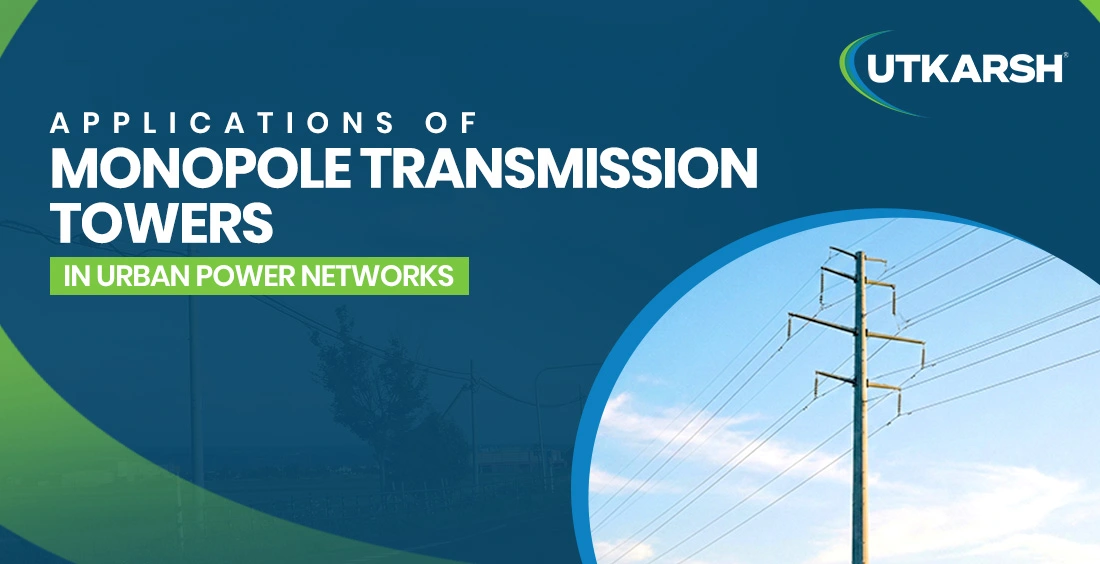
Rapid urbanisation is putting immense pressure on city power networks. Narrow roads, congested corridors, high real-estate costs, and strict municipal regulations make it extremely difficult to install conventional lattice towers.
Traditional structures demand larger footprints, complex foundations, and extended installation time - causing traffic disruption, public inconvenience, and project delays. In dense commercial and residential zones, even minor construction activities can trigger logistical challenges and regulatory hurdles.
This is where the monopole transmission tower emerges as a future-ready solution. Compact, structurally strong, and aesthetically streamlined, power transmission monopole structures are specifically engineered to address the spatial and operational constraints of urban power networks.
Why Monopole Transmission Towers are Ideal for Urban Networks
A monopole transmission tower features a single tubular steel shaft designed to support overhead transmission and distribution lines. Unlike lattice towers, transmission monopoles occupy minimal ground space while maintaining structural strength and load-bearing efficiency.
For cities expanding vertically and horizontally, monopole towers for urban areas offer unmatched advantages in deployment, maintenance, and visual integration.
Applications of Monopole Transmission Towers in Urban Power Networks
1. Urban Transmission Line Corridors
In metropolitan regions, acquiring wide Right-of-Way (ROW) is expensive and often impractical. Transmission monopoles are extensively used in:
- City-to-substation interconnections
- High-density residential zones
- Commercial and IT corridors
- Industrial clusters within municipal limits
Their slim profile enables installation along medians, sidewalks, and restricted pathways without obstructing traffic or pedestrian movement.
2. Substation Connectivity Within City Limits
Urban substations often operate in space-constrained areas. Power transmission monopole structures efficiently connect substations to overhead grids where conventional multi-leg towers cannot be accommodated.
Their compact base design ensures:
- Reduced foundation footprint
- Optimised land utilisation
- Faster civil work completion
This makes them particularly suitable for modern urban grid expansion projects.
3. Smart City and Multi-Utility Infrastructure Integration
Modern cities are transitioning toward integrated utility frameworks. Monopole towers for urban areas can support more than just transmission lines. They are frequently deployed to integrate:
- Power conductors
- Street lighting arms
- CCTV and surveillance systems
- Telecom equipment
- Traffic monitoring sensors
This multi-functional capability reduces the need for separate infrastructure installations, supporting smart city development while maintaining urban aesthetics.
4. Replacement and Upgradation of Existing Towers
In many cities, aging lattice towers need replacement due to corrosion, increased load demand, or urban redevelopment projects.
A monopole transmission tower is often preferred for retrofit projects because:
- It requires less space than legacy towers
- Installation is faster with minimal disruption
- It supports upgraded conductor configurations
This makes monopoles ideal for modernisation initiatives in existing power corridors.
5. River Crossings and Elevated Urban Structures
Urban transmission lines often cross:
- Flyovers
- Railway lines
- Rivers and canals
- Metro corridors
Power transmission monopole structures provide enhanced height flexibility and structural stability, making them suitable for elevated alignments within city infrastructure.
6. Renewable Energy Integration in Urban Grids
With rooftop solar adoption and decentralised energy generation increasing, urban networks require flexible interconnection structures.
Transmission monopoles facilitate:
- Compact interconnection systems
- Reduced land dependency
- Efficient integration with distributed generation networks
They support evolving urban power architecture with scalability.
Also Read: How Wind and Seismic Loads are Addressed in Monopole Towers
Engineering Advantages That Support Urban Applications
1. Minimal Footprint – Perfect for congested zones
One of the most defining features of a monopole transmission tower is its compact base structure. Unlike conventional lattice towers that require multiple legs and wide foundations, transmission monopoles are single-shaft tubular structures that significantly reduce ground coverage.
2. High Structural Strength – Designed for wind and load resistance
Urban transmission systems must withstand dynamic loads, including wind pressure, conductor tension, seismic forces, and environmental stresses. Power transmission monopole structures are designed using advanced structural techniques.
3. Hot-Dip Galvanised Finish – Enhanced corrosion protection
Urban environments expose transmission structures to pollution, humidity, industrial emissions, and coastal salinity. Corrosion resistance is therefore critical.
High-quality transmission monopoles undergo hot-dip galvanisation, which provides:
- Uniform zinc coating protection
- Long-term resistance against rust
- Reduced structural degradation
- Extended service life
This protective finish ensures that power transmission monopole structures maintain structural integrity even in aggressive urban atmospheres, significantly lowering lifecycle costs.
4. Modular Fabrication – Faster on-site assembly
Speed and safety are crucial in city-based projects where prolonged construction can disrupt traffic and daily activities. Modular design reduces installation time, labour requirements, and urban inconvenience. For utilities operating under tight deadlines, monopole towers for urban areas ensure faster project commissioning.
5. Lower Maintenance Needs – Long operational life
Urban power infrastructure must operate reliably with minimal intervention. Due to their simplified structure, transmission monopoles offer:
- Fewer components compared to lattice towers
- Reduced bolt and joint inspection points
- Enhanced corrosion protection
- Lower risk of structural fatigue
This translates to:
- Lower maintenance costs
- Reduced inspection frequency
- Improved grid reliability
- Long-term performance stability
For utility companies, investing in a monopole transmission tower means improved operational efficiency and reduced lifecycle expenditure.
Why Choose Utkarsh India for Monopole Transmission Towers?
When infrastructure reliability is non-negotiable, expertise and engineering integrity matter. Utkarsh India stands among the trusted manufacturers of monopole transmission tower solutions in India, backed by:
Engineering Expertise
Advanced design and manufacturing processes ensure structurally sound and performance-optimised transmission monopoles.
Quality Assurance
Strict quality control protocols, precision fabrication, and high-grade steel sourcing ensure durability and compliance with industry standards.
Proven Manufacturing Infrastructure
With modern production facilities and galvanisation capabilities, Utkarsh India delivers large-scale, high-performance power transmission monopole structures tailored to project specifications.
Industry Experience
Years of experience in infrastructure manufacturing reinforce Utkarsh India’s credibility in delivering reliable, high-strength structures for demanding urban environments.
Client-Centric Approach
From design consultation to project execution, the company supports utilities, EPC contractors, and power developers with technically sound and cost-efficient solutions.
Conclusion
As cities grow denser and power demand rises, infrastructure must evolve intelligently. The monopole transmission tower is redefining urban grid deployment through space efficiency, structural strength, faster installation, and aesthetic adaptability. The role of monopole tower 5G expansion is becoming increasingly significant in enabling higher network density and seamless connectivity across modern urban environments.
From smart cities to substation connectivity and renewable integration, monopole towers for urban areas are playing a transformative role in modern power networks.
For reliable, high-performance transmission monopoles, Utkarsh India delivers engineering excellence built to power tomorrow’s cities.
FAQs
1. What is a monopole transmission tower?
A monopole transmission tower is a single-pole steel structure used to support overhead power lines in urban and space-constrained areas.
2. Why are monopole towers preferred in urban areas?
They require less space, offer faster installation, and blend better with city landscapes compared to traditional lattice towers.
3. Are monopole transmission towers durable?
Yes, they are made from high-grade steel with galvanised coatings for corrosion resistance and long service life.
4. Can monopole towers support multiple utilities?
Yes, they can integrate power lines, lighting arms, telecom equipment, and smart city components.
5. Who manufactures reliable monopole transmission towers in India?
Utkarsh India is a trusted manufacturer offering high-quality, durable transmission monopole solutions for urban power networks.