

Naye India Ka Utkarsh: The Steel Structures Behind Everyday India
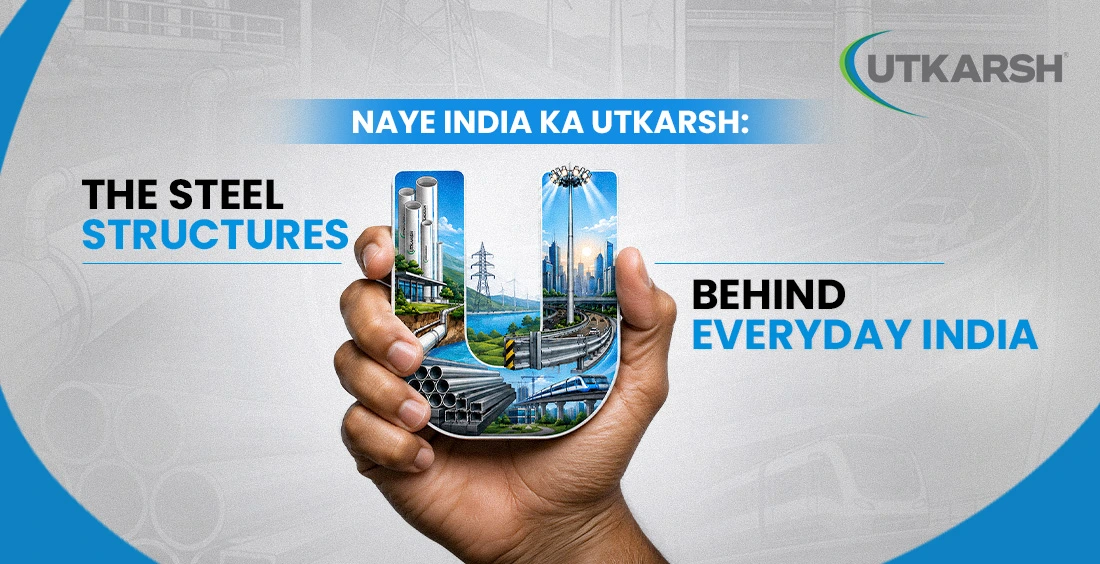
A lit highway at midnight. A local train running on time. A phone call that connects on the first ring. We rarely stop to think about what makes these everyday moments possible.
The answer, more often than not, is steel. Crash barriers, high masts, transmission towers, OHE masts and solar frames form the backbone of modern India. And behind thousands of kilometres of that backbone stands Utkarsh India.
Infrastructure Development in India: The Numbers Behind the Growth
India is building at a pace it has never seen before. A few figures put the scale in perspective:
- ₹12.2 lakh crore in public capital expenditure has been allocated for FY 2026-27, a record high and roughly 9% more than the previous year (Union Budget 2026-27).
- 1,46,572 km is the length of India's National Highway network as of February 2026, up from 91,287 km in March 2014 (New India Samachar, PIB).
- 5,313 km of National Highways were built by NHAI in FY 2025-26, about 15% above target (NHAI).
- 99.6% of the broad gauge rail network is now electrified, making Indian Railways the world's second-most electrified large rail system (Ministry of Railways, July 2026).
- 168 GW+ of solar capacity was installed in India by August 2026 (MNRE).
Every one of these milestones depends on structural steel. That is why the quality of steel structures in India directly shapes the safety, reliability and lifespan of the country's infrastructure.
Steel Structures in India: The Utkarsh India Product Range
Metal Beam Crash Barriers
Crash barriers absorb the energy of a vehicle on impact and steer it back onto the carriageway, preventing it from crossing a median or falling off an embankment.
Range: W-beam and thrie-beam crash barriers in conventional and higher containment (H1 and H2) variants, along with pedestrian barriers, noise barriers and railway crash barriers.
With India adding thousands of kilometres of highways every year, Utkarsh India's galvanised barriers already safeguard 40,000+ km of roads, including projects for NHAI and leading highway EPC contractors.
High Mast Lighting Systems
High masts light up large areas such as highway interchanges, toll plazas, ports, stadiums and railway yards from a single tall structure, improving visibility and safety at night.
Range: High masts, flag masts, signage masts and stadium masts.
Engineered to withstand wind speeds of up to 300 kmph, Utkarsh India's masts are built for India's cyclone-prone coastlines. More than 1,00,000 lighting masts supplied by the company stand across the country today.
Railway Electrification Structures
Electric trains draw power from overhead wires, and those wires need precisely engineered steel supports along every kilometre of track.
Range: OHE structures including RSJ masts, BFB masts, portals, steel pole structures, TSS and SSP structures, plus elastic rail clips (ERC).
As India closes in on 100% broad gauge electrification, Utkarsh India's structures support around 20,000 km of electrified railway routes, with Eastern, Northern, South Eastern and Western Railways among its clients.
Transmission and Telecom Towers
Towers carry high-voltage power lines from generating stations to cities and carry mobile and data signals across the country.
Range: Lattice transmission towers, transmission monopoles, substation structures and telecom towers.
Utkarsh India's structures support 1,00,000+ telecom towers and power networks for utilities such as Power Grid, NTPC and several state electricity boards.
Solar Module Mounting Structures
A solar plant is only as reliable as the frame holding its panels. Mounting structures must hold modules at the correct tilt through wind, rain and heat for the full life of the project.
Range: Ground-mounted fixed tilt, rooftop and tracker structures (torque tube and piers trackers), PM-KUSUM project structures and ballast structures.
With solar capacity growing by over 34 GW in the first eight months of 2026 alone, Utkarsh India supplies hot-dip galvanised structures customised for both utility-scale and rooftop projects.
Poles, Pipes and Pre-Engineered Buildings
These are the structures closest to daily life, from the streetlight outside your gate to the pipeline bringing water to your tap.
Range: Steel tubular poles for street lighting, power distribution and solar; polygonal and octagonal poles including CCTV poles; GI pipes, MS pipes and ERW hollow sections; and pre-engineered metal buildings.
Utkarsh India has supplied 20,00,000+ lighting poles, and its GI pipes have been used in the Jal Jeevan Mission in Sikkim and PHE Division water supply schemes in West Bengal.
Built to Last: Galvanisation for Modern Infrastructure in India
Monsoon humidity, coastal salt and industrial pollution can corrode bare steel within a few years. Hot-dip galvanisation solves this by bonding a protective zinc layer to the steel surface.
At Utkarsh India, products go through a 7-tank galvanisation process using 99.95% pure zinc sourced from Hindustan Zinc Limited. The company is ISO 9001:2015 certified, manufactures to IS and ASTM standards, and runs in-house quality testing at every stage. The result is lower maintenance, fewer replacements and longer service life for every project.
Also Read: A Complete Overview of the Hot-Dip Galvanisation Process in GI Pipe Manufacturing
Why Utkarsh India is a Trusted Partner for India's Infrastructure Development
- 40+ years of experience in galvanised steel fabrication
- 4.8 lakh MT annual production capacity
- 10,000+ customers across roads, rail, power, telecom, solar and water
- Clients including NHAI, Indian Railways, Power Grid, NTPC, Larsen & Toubro, Tata Projects and major port authorities
From a single streetlight pole to a full highway safety package, Utkarsh India brings the capacity, engineering depth and quality control that large public projects demand. It is this track record that has made Utkarsh India the best infrastructure company in India for contractors and agencies building Naye India.
Planning a road, rail, power or solar project? Get in touch with the Utkarsh India team for customised steel structure solutions.
FAQs
1. What are the most common steel structures used in India's infrastructure?
The most common steel structures include crash barriers, high mast lighting systems, railway OHE masts, transmission and telecom towers, solar mounting structures, steel poles and GI pipes.
2. Why is galvanised steel preferred for infrastructure projects in India?
Galvanised steel has a zinc coating that protects it from rust caused by humidity, rain and coastal salt. This extends service life and reduces maintenance costs in India's varied climate.
3. What steel structures does Utkarsh India manufacture?
Utkarsh India manufactures metal beam crash barriers, high mast lighting systems, railway electrification structures, transmission and telecom towers, solar mounting structures, steel tubular and octagonal poles, GI and MS pipes, and pre-engineered metal buildings.