

A Guide to Choosing the Right Traffic Signal Light Pole for Urban Roads
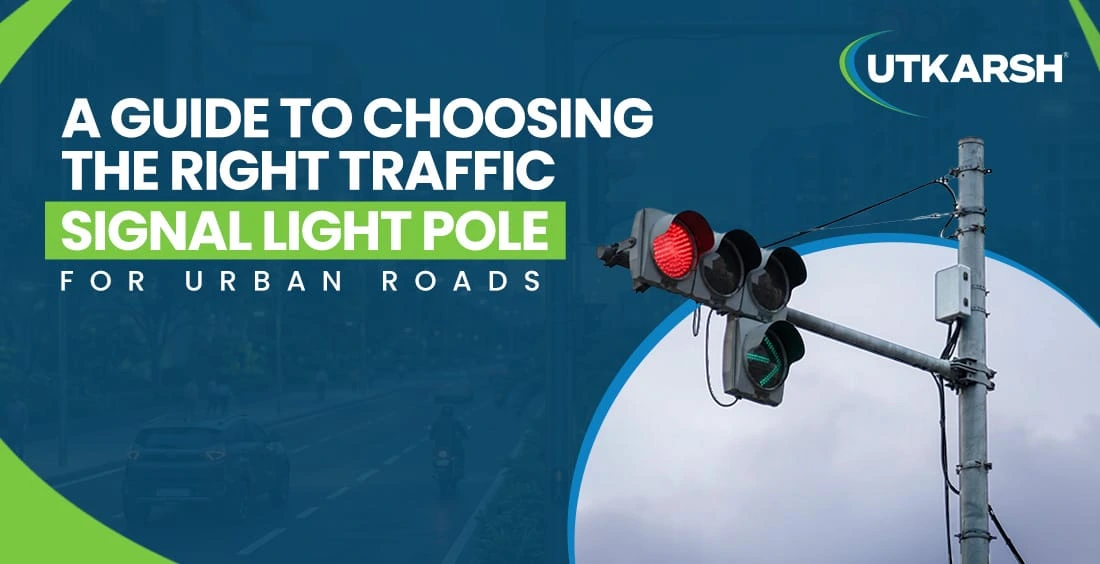
The efficiency of urban mobility doesn't just depend on the timing of the lights; it rests on the structural integrity of the traffic signal light pole supporting them. In modern cities, these poles are critical safety assets that must withstand environmental stress, ensure driver visibility, and integrate with smart city technology.
As leading traffic signal pole manufacturers, Utkarsh India understands that a pole is an engineering solution, not just a steel post. This guide outlines the essential factors for choosing the right infrastructure for urban roads.
Key Factors for Selecting the Ideal Traffic Signal Structure
1. Geometric Alignment and Visibility
The primary goal of a traffic signal is visibility. National standards, such as the Manual on Uniform Traffic Control Devices (MUTCD), emphasize placing signals within a driver's cone of vision, typically a 20° range from the center of the approach.
- Cantilever (Mast Arm) Poles: These are the gold standard for multi-lane urban roads. They extend the signal directly over the travel lanes, ensuring visibility even in heavy traffic. Typical mast arm lengths range from 30 to 70 feet, depending on road width.
- Signal Pedestals: Usually 8 to 10 feet tall, these are used for pedestrian crossings or secondary roads where overhead signals aren't required.
- Gantry Structures: Used for high-volume expressways to support multiple signal heads and digital signage across several lanes.
2. Structural Integrity and Wind Resistance
Urban environments subject poles to "wind tunnel" effects between buildings and extreme weather events.
- Wind Load Capacity: Poles must be engineered to withstand regional wind speeds (often up to 200 km/hr or more in coastal areas).
- Vibration Dampening: Continuous wind buffeting can lead to fatigue. High-quality poles are designed to minimize sway or dynamic amplification, which protects sensitive LED signal heads and surveillance cameras.
- Standard Compliance: Look for poles designed according to standards like IS 875 Wind Load and IS 2062 Structural Steel to ensure they can handle both Dead Loads (equipment weight) and Live Loads (wind and environmental pressure).
3. The 7-Tank Hot-Dip Galvanization Advantage
Corrosion is the leading cause of structural failure in road infrastructure. To ensure a lifespan of 25+ years, the material must be protected.
- Corrosion Protection: Utkarsh India uses a 7-tank hot-dip galvanization process. This creates a metallurgical bond between the zinc and steel, providing a rugged coating that prevents rust even in humid, high-pollution, or coastal environments.
- Maintenance: Galvanized poles require significantly less maintenance than painted poles, reducing long-term costs for urban municipalities.
4. Safety and Clear Zone Requirements
Urban planners must consider the clear zone, the lateral distance from the edge of the traveled way to the pole.
- Lateral Clearance: In urban areas with curbs, a minimum clearance of 1.5 to 2 feet behind the curb is standard to prevent vehicle collisions.
- Breakaway Designs: In high-speed zones, poles may require breakaway or yielding characteristics to minimize injury and vehicle damage during a collision.
5. Smart City Integration
Modern urban roads are evolving, and their street light poles are supporting smart city projects. The right road signal pole should be future-ready:
- Internal Cabling: Weatherproof, vandal-resistant flush doors and internal wiring channels are essential for protecting the electrical components.
- Multi-Functional Use: Modern Smart Poles integrate traffic signals with CCTV, 5G small cells, Wi-Fi hotspots, and environmental sensors.
Selection Checklist for Urban Planners
| Feature | Requirement | Benefit |
|---|---|---|
| Material | High-Tensile Steel (IS 2062) | Maximum structural strength. |
| Coating | 7-Tank Hot-Dip Galvanized | 25+ years of rust protection. |
| Welding | Automatic Submerged Arc (SAW) | Uniform, deep-penetration joints. |
| Height | 15 ft Minimum Vertical Clearance | Allows all legal-height vehicles to pass. |
Check out our blog: Useful insights on the choice of street light pole
Why Choose Utkarsh India?
As a premier steel manufacturing company with over four decades of expertise, Utkarsh India is dedicated to Building a Stronger Nation. Our traffic structures are not just products; they are high-performance engineering solutions. From state-of-the-art manufacturing plants to rigorous quality testing, we ensure every road signal pole meets the highest international safety and durability standards.
Whether you are developing a new highway, upgrading a busy city intersection, or launching a Smart City project, Utkarsh India provides the reliability and structural integrity your project demands.
Conclusion
Choosing the right traffic signal light pole is a decision that impacts urban safety, municipal budgets, and city aesthetics for decades. A well-engineered pole does more than just hold a light; it stands as a silent guardian against extreme weather, resists the corrosive toll of urban pollution, and integrates seamlessly into the smart infrastructure of tomorrow. By prioritizing high-tensile steel, 7-tank hot-dip galvanization, and wind-resistant designs, urban planners can ensure that their roads remain safe and their maintenance costs stay low.
FAQs:
1. What is the average lifespan of these poles?
Built to last 25+ years, our poles utilize a premium 7-tank hot-dip galvanization process that prevents rust and structural decay even in high-pollution or coastal environments.
2. Can the poles withstand extreme weather and high winds?
Yes. Our poles are engineered to withstand wind speeds of up to 300 km/hr, ensuring structural stability during cyclones and severe urban storms.
3. Are your traffic poles compatible with Smart City technology?
Absolutely. We design multi-functional poles that can seamlessly integrate CCTV cameras, Wi-Fi, IoT sensors, and 5G small cells alongside traditional signals.
4. Why choose galvanized steel over painted poles?
Unlike paint, which chips and peels, hot-dip galvanization creates a permanent metallurgical bond that prevents corrosion from the inside out, significantly reducing maintenance costs.