

A Guide to Choosing the Right Electric Pole for Utility Projects
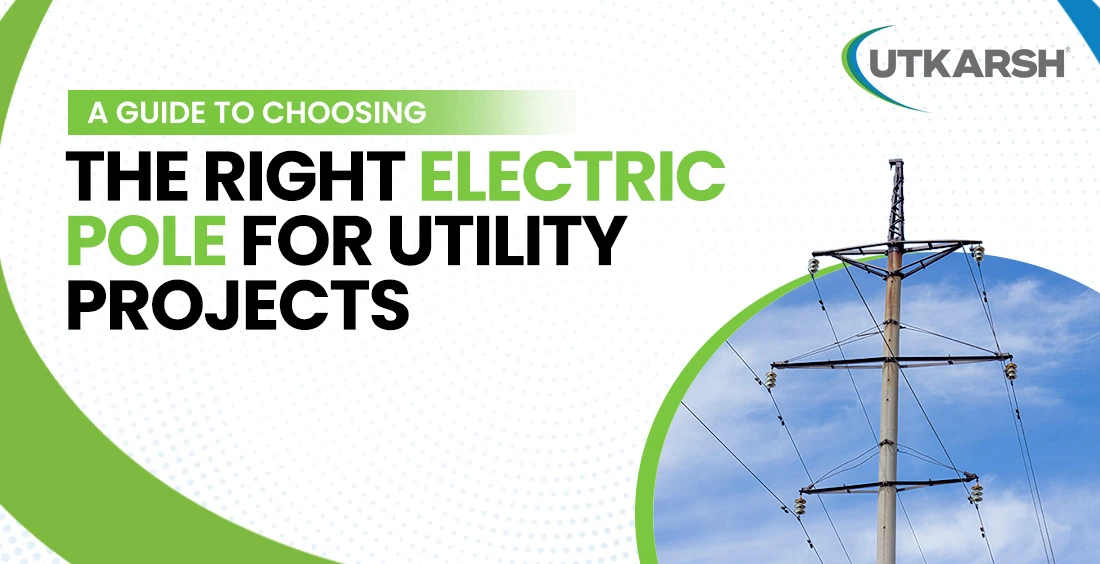
Every utility project, whether it is rural electrification, a solar park, or a substation upgrade, stands or falls on one component: the electric pole. Get the specification wrong, and the consequences are not happening. There are outages, safety hazards, and budgets that spiral when poles have to be replaced years before their intended lifespan.
The reason this decision carries so much weight is simple. An electric pole is not just a support structure; it is the load-bearing spine of the entire power distribution network. It carries live conductors, transformers, and cross-arms while facing wind loads, corrosive weather, and decades of continuous stress. A pole that cannot handle these forces puts the whole grid at risk, not just the stretch of line it holds up.
Why Electric Poles are Central to Utility Projects
Utility projects, power transmission, distribution, substations, and rural electrification, all depend on a continuous, uninterrupted physical structure to carry conductors from the source to the end user. The electric pole is that structure. It has to:
- Support the mechanical weight of conductors, transformers, and hardware
- Resist dynamic wind loading, including the "galloping" effect caused by high-speed winds on suspended cables
- Withstand corrosion from humidity, industrial pollutants, and coastal salt exposure
- Maintain electrical clearance and structural stability across decades of service
- Allow for efficient installation across difficult or remote terrain
Because utility projects are typically large in scale, spanning entire districts, industrial belts, or state grids, even a small design flaw in the pole gets multiplied across thousands of units. This is why utility procurement teams evaluate poles not as standalone hardware but as a system-critical asset.
Types of Electric Poles Used in Utility Projects
Not every utility project calls for the same pole. The right choice depends on load requirements, terrain, and the specific application within the power network.
Steel Electric Pole (Tubular and Swaged)
The steel electric pole remains the backbone of most modern power distribution pole networks. Steel offers uniform material strength across the entire structure, which means more predictable performance and longer span lengths compared to conventional RSJ or PCC/PSC poles. Steel is also inherently ductile, so it tends to bend under extreme stress rather than snap, reducing the risk of catastrophic failure in the field.
Polygonal and Octagonal Poles
Polygonal steel poles are engineered for power distribution, solar installations, and substation connectivity. Their shape improves wind resistance and load distribution, making them a preferred option for utility projects that need both strength and a cleaner structural profile.
Power Distribution Poles
Purpose-built for carrying overhead lines from substations to homes, businesses, and industries, power distribution poles are the most widely deployed category in utility work. They need to support single circuit, double circuit, and multi-circuit configurations while managing voltage drop and line heat capacity across long distances.
Transmission Monopoles and Structures
For higher-voltage transmission corridors, monopoles and transmission structures step in to carry heavier loads across longer spans, often in more exposed terrain.
What to Evaluate Before Choosing an Electric Pole
1. Compliance with IS-2713/80 Standards
In India, IS-2713/80 (Part 1 to 3) is the benchmark standard for steel tubular poles. A pole that conforms to this standard is engineered for dynamic loading, including wind-induced galloping, and offers the tensile strength and ductility needed to absorb shocks without failure. Any electric pole manufacturer worth considering should be able to demonstrate compliance as a baseline, not an add-on.
2. Hot-Dip Galvanization for Corrosion Resistance
Rust is the single biggest long-term threat to any steel electric pole. Hot-dip galvanization, with a uniform zinc coating typically between 65 microns and 86 microns, forms a metallurgical bond with the steel that acts as a self-healing shield, protecting the pole even if the surface gets scratched during installation or transport.
3. Raw Material Quality
A pole is only as strong as the steel it is made from. Sourcing HR coils and steel from primary producers ensures uniform thickness, better weldability, and consistent compliance with chemical and mechanical property requirements. This directly affects how the pole performs under real-world stress, not just on a lab test sheet.
4. Testing and Validation
Reliable manufacturers subject every batch to rigorous testing, including deflection testing, drop testing, and permanent set testing, to confirm the pole holds its shape and joint integrity under maximum load. This step separates manufacturers who simply produce poles from those who engineer them for utility-grade reliability.
5. Customisation and Logistics
Utility projects rarely follow a one-size-fits-all specification. Height, load configuration, and terrain vary from a Himalayan hill station to a coastal DISCOM network. A capable power distribution pole supplier should offer customisable designs along with the logistical capacity to deliver to remote project sites on schedule.
Also Read: Selecting the Right Electric Pole Manufacturer in India for Power Projects
Utkarsh Achieves Milestones: Electric Poles Powering Real Utility Projects
Utkarsh India's transmission and power distribution poles have been deployed across some of India's most demanding utility environments, each with a different engineering challenge. Here are a few examples of that work in action.
| Project Name | Description | Kind of Utility Project |
|---|---|---|
| Energy and Power Department of Sikkim | A1 Type and E1 Type poles supplied for a lighting project in Pangthang, Gangtok, and Rangpo under PGCIL (Power Grid Corporation of India Limited), addressing hilly terrain and logistical challenges. | Rural and hill-terrain electrification |
| National Thermal Power Corporation (NTPC) | 7.5 metre and 4.5 metre HDGI poles supplied for the NTPC Fatehgarh solar project, built for corrosion-resistant, weather-stable performance. | Solar power infrastructure |
| Gujarat Industries Power Company Limited | 5 metre GI poles supplied for a lighting project in Charanka Village, Santalpur, Patan, delivered via Vikram Solar for one of India's major solar parks. | Solar park lighting and power distribution |
| Adani Electricity Mumbai Ltd (Mumbai Zone Electrification) | 5.5 metre and 7.5 metre GI poles supplied for the Mumbai Electricity DISCOM network under AEML, covering Mumbai and Navi Mumbai, where coastal humidity demands corrosion-resistant poles. | Urban DISCOM power distribution |
Each of these examples reflects a different combination of terrain, load, and environmental stress, which is exactly why utility procurement teams need an electric pole manufacturer capable of engineering for variation rather than supplying a generic product.
Manufacturing Process Behind a Reliable Electric Pole
Understanding how a power distribution pole is made helps utility planners evaluate quality beyond the spec sheet:
- Raw material sourcing: High-grade steel and zinc, sourced from trusted vendors, form the base material.
- Sheet cutting and trapezoidal cutting: Precision machinery and CNC plasma cutting shape the sheets for structural consistency.
- CNC press brake forming: Sheets are bent to exact angles for uniform pole geometry.
- Welding and grinding: Joints are formed and finished for structural integrity and a smooth surface.
- Base plate and door fitting: Base plates and access doors are fitted for stability and accessory placement.
- Hot-dip galvanization: A multi-tank galvanizing process coats the pole for long-term corrosion resistance.
- Straightening, packaging, and dispatch: Final quality checks precede careful packaging and delivery to the project site.
This level of process control is what separates a dependable steel electric pole from one that will need premature replacement.
Conclusion
Selecting the right electric pole for a utility project is not a minor procurement checkbox; it is a decision that determines how reliably a grid performs for decades. Standards compliance, galvanization quality, raw material sourcing, and rigorous testing all combine to decide whether a pole becomes an asset or a recurring liability.
Utkarsh India brings the experience, expertise, authority, and trust that utility projects require from a manufacturing partner. With four decades of experience in steel fabrication company with galvanization, an IS-2713/80 compliant production line with a capacity of 2,50,000 poles per annum, and a track record with organisations like PGCIL, NTPC, and Adani Electricity, Utkarsh India has the demonstrated authority of an established electric pole manufacturer. Every batch is validated through in-house deflection, drop, and permanent set testing, reinforcing the trust that utility planners place in a proven power distribution pole supplier for projects that cannot afford to fail.
Talk to Utkarsh India's engineering team to find the right electric pole specification for your next utility project.
Frequently Asked Questions
1. What makes an electric pole suitable for utility projects specifically?
An electric pole suited to utility work must comply with IS-2713/80 standards, offer high wind resistance, and be hot-dip galvanized to handle continuous exposure to weather and load stress across a large-scale network.
2. Why is a steel electric pole preferred over PCC or wooden poles for utility work?
A steel electric pole offers uniform strength, higher ductility, and a longer service life than PCC or wooden alternatives. It bends under extreme stress instead of snapping, which reduces the risk of sudden structural failure.
3. How does an electric pole manufacturer ensure quality for utility projects?
A reliable electric pole manufacturer sources certified raw materials, follows hot-dip galvanization for corrosion resistance, and runs every batch through deflection, drop, and permanent set testing before dispatch.
4. Can the same power distribution pole be used for both urban and coastal utility projects?
Power distribution poles can be customised for different environments, but coastal and high-humidity locations require enhanced galvanization thickness compared to standard urban deployments to prevent premature corrosion.