

Why Quality Agricultural Pipes Are Crucial for Sustainable Farming?
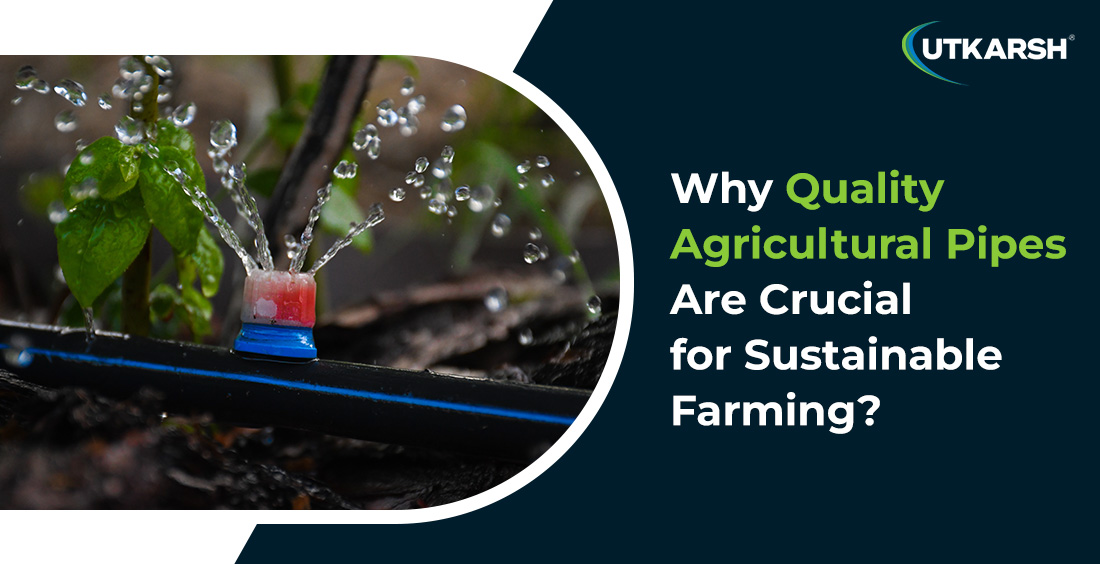
Agriculture uses about 80% of India's utilisable water resources, according to Central Water Commission figures. Yet a National Academy of Agricultural Sciences policy paper puts the overall water use efficiency of India's irrigation projects at only 35 to 40%. A lot of water is lost before it ever reaches a plant.
Some of that loss happens inside the pipe network itself. Leaking joints, cracked lines and pipes that can't handle the pump's pressure all waste water, power and money. The quality of the pipe you lay decides how much of what you pump actually reaches the field.
This guide covers why quality agricultural pipes matter, how uPVC, HDPE and GI compare, how to pick the right pressure class, and what to check before you buy.
Key takeaways
- uPVC pipes work best as buried mains and sub-mains. HDPE suits flexible lateral and sprinkler lines.
- Match the pipe's pressure class to your pump's total head, not just its horsepower.
- Agricultural uPVC pipes should carry the ISI mark under IS 4985:2021 with a valid BIS licence number printed on the pipe.
- Small and marginal farmers can get 55% assistance for drip and sprinkler systems under Per Drop More Crop.
1. Efficient water delivery from source to field
On most Indian farms, water travels from a borewell, canal or farm pond through a network of pipes in an agricultural water system before it reaches the crop. In drip and sprinkler setups, rigid uPVC pipes usually form the mains and sub-mains that feed the system, while smaller polyethylene laterals carry water to the plants. That's why HDPE pipes for drip irrigation and uPVC mains often work side by side on the same field.
When the mains leak, everything downstream suffers. Pressure drops, emitters at the far end get less water, and the pump has to run longer to make up the shortfall. A well-made pipe with consistent wall thickness and tight joints holds pressure across the whole run. The result is even watering and lower pumping costs.
2. Durability under field conditions
Farm pipes deal with shifting soil, fertiliser residues, heat and the weight of tractors passing overhead. Poor-quality pipes crack, split at the socket or turn brittle within a few seasons. Each failure means digging, replacing and losing irrigation days.
Good uPVC pipes don't rust or scale the way steel does, and they resist most fertilisers and soil chemicals. They are rigid, though, not flexible. Where a line has to bend around obstacles or be laid in coils over long distances, HDPE is the better fit. uPVC also degrades if left in direct sunlight for long periods, so it performs best when buried.
3. Water conservation and soil health
Every litre that leaks out of a pipe is a litre pumped for nothing. In areas where groundwater is falling, a leak-free network is one of the simplest ways to conserve agricultural water. Fewer leaks also mean the pump runs for less time, which cuts diesel or electricity use.
Pipes matter for drainage too. Waterlogged fields damage roots, wash out nutrients and slowly degrade the soil. A properly laid drainage line keeps excess water moving out of the root zone and protects soil health over the long term.
4. Fewer crop losses
Uneven water distribution shows up quickly in the crop. Plants near the source get too much, plants at the far end get too little, and yields vary across the same field. Blockages and sudden pressure drops can also cause stunted growth or crop failure during dry spells. Pipes rated for the right pressure and laid correctly keep distribution even from one end of the field to the other.
uPVC vs HDPE vs GI pipes for agriculture
Each material has a place on the farm. The table below compares them on the points that matter most for irrigation.
| Factor | uPVC pipes | HDPE pipes | GI pipes |
|---|---|---|---|
| Indian standard | IS 4985:2021 | IS 4984:2016 | IS 1239 (Part 1) |
| Flexibility | Rigid | Flexible, available in coils | Rigid |
| Weight | Light | Light | Heavy |
| Corrosion | Does not corrode | Does not corrode | Zinc coating protects, but can rust once damaged |
| Jointing | Solvent cement or socket joints | Butt fusion or compression fittings | Threaded joints |
| Sunlight exposure | Best buried or shaded | Handles exposure better | Handles exposure well |
| Typical farm use | Buried mains and sub-mains | Laterals, sprinkler lines, long flexible runs | Risers and above-ground sections needing strength |
For a deeper look at polyethylene, read all you need to know about HDPE pipes. For risers and exposed sections, GI pipes add mechanical strength.
How to choose the right pipe class for your pump
uPVC pipes under IS 4985 come in pressure classes. The class tells you the working pressure the pipe is built to handle. A useful rule of thumb: 1 kgf/cm² of pressure equals roughly 10 metres of water head.
| Pipe class | Working pressure | Approx. water head |
|---|---|---|
| Class 1 | 2.5 kgf/cm² | About 25 m |
| Class 2 | 4.0 kgf/cm² | About 40 m |
| Class 3 | 6.0 kgf/cm² | About 60 m |
Higher classes are available for pumps with greater head. To pick the right one, add up the vertical lift, the friction loss along the pipe length and a safety margin for pressure surges when the pump starts or stops. Then choose a class whose working pressure sits comfortably above that total. Undersizing is a common reason pipes burst near the pump outlet.
Signs of poor-quality agricultural pipes
- No ISI mark or licence number: A BIS-certified pipe carries the ISI mark, the IS number, size, class and the manufacturer's CM/L licence number printed along its length. You can check a licence number on the BIS Care app.
- Uneven wall thickness: Look at a cut end. If one side is visibly thinner, the pipe will weaken at that spot under pressure.
- Brittleness: Pipes that crack, chip or whiten easily when handled are likely made with too much filler.
- Rough or patchy surfaces: Good uPVC has a smooth, uniform finish inside and out. Rough interiors also slow water flow.
- Loose-fitting sockets: If the socket wobbles on the pipe before jointing, the joint is likely to leak later.
Installation tips for longer pipe life
- Bury uPVC lines: Keep them out of direct sunlight. A cover of at least 60 cm of soil is common practice, with more depth where tractors and heavy vehicles cross.
- Prepare the trench bed: Remove stones and sharp objects, and bed the pipe on fine soil or sand so it is supported evenly along its length.
- Let solvent joints cure: Follow the solvent cement maker's curing time before you pressurise the line.
- Protect exposed sections: Where a pipe has to run above ground, shade it, paint it or switch to HDPE or GI for that stretch.
- Test before backfilling: Run water through the line and check every joint for leaks while the trench is still open.
Government support for efficient irrigation
Two central schemes make efficient irrigation more affordable for Indian farmers.
Per Drop More Crop (PDMC): Under this micro-irrigation scheme, small and marginal farmers receive 55% financial assistance for micro-irrigation systems, and other farmers receive 45%, according to the Press Information Bureau. PDMC was a component of PMKSY and is now part of PM-RKVY. Per the scheme guidelines, assistance is capped at five hectares per beneficiary, and some states add their own top-up subsidy.
PM-KUSUM: Component B of PM-KUSUM lets farmers in off-grid areas install standalone solar pumps of up to 7.5 HP, often replacing diesel pumps. Central financial assistance covers 30% of the benchmark or tender cost, whichever is lower, rising to 50% in north-eastern and hill states and islands. Utkarsh India also manufactures solar mounting structures for PM-KUSUM projects.
Utkarsh India's agricultural PVC pipes
Utkarsh India manufactures agriculture PVC pipes to IS 4985:2021 under BIS Licence CM/L 0005819583. The pipes come in sizes from 25 mm to 315 mm across multiple pressure classes, and are available plain-ended or with a socket at one end.
Agricultural uPVC pipes are classed as Type B under IS 4985:2021, the category that India's Lead Stabilizer in PVC Pipes and Fittings Rules list for agricultural use. If you need help choosing a size or class for your farm, our team can guide you based on your pump and field layout.
FAQs
Which pipe is best for agriculture in India?
It depends on where the pipe goes. uPVC pipes to IS 4985:2021 are a common choice for buried mains because they are light, corrosion-free and economical. HDPE pipes suit flexible laterals and sprinkler lines, while GI pipes are used for risers and exposed sections that need extra strength.
What is the difference between uPVC and HDPE pipes for irrigation?
uPVC is rigid and joined with solvent cement or sockets, and it performs best when buried. HDPE is flexible, comes in long coils, handles sunlight better and is joined by fusion or compression fittings. Many farms use uPVC for mains and HDPE for laterals.
Which pressure class of PVC pipe should I use for a submersible pump?
Calculate the total head your pump works against, including vertical lift, friction loss and a margin for pressure surges. As a rough guide, 1 kgf/cm² equals about 10 m of head, so a Class 2 pipe at 4.0 kgf/cm² suits roughly 40 m. Choose a class with a working pressure comfortably above your total.
How can I check if an agricultural PVC pipe is BIS certified?
Look for the ISI mark, the standard number (IS 4985:2021), size, class and a CM/L licence number printed on the pipe. You can verify the licence number on the BIS Care app.
Is there a government subsidy for irrigation systems?
Yes. Under Per Drop More Crop, small and marginal farmers can get 55% assistance and other farmers 45% for drip and sprinkler systems, for up to five hectares. Under PM-KUSUM Component B, central assistance covers 30% of the cost of standalone solar pumps in most states.