

Why Do Water Tanks Get Algae? How Multi-Layer Tanks Prevent It
You open the lid of your rooftop tank and notice a green film on the walls. The tap water smells a little earthy. Maybe there is a slimy layer near the bottom that was not there a few months ago.
That is water tank algae, and it is one of the most common complaints in Indian homes, especially during the hot and humid months. Algae does not appear by chance. It grows only when certain conditions are present, which means you can stop it.
Below, we cover why algae grows in a water tank, how it differs from fungus and bacteria, what you can do about it at home, and why a multi layer water tank is the most reliable long-term fix.
In short: Algae needs three things to grow: light, warmth and nutrients. In India, you cannot control the heat, so the most effective step is to keep light out of the tank. A well-built multi-layer tank with a light-blocking wall, a tight lid and a food-grade, antimicrobial inner layer removes the conditions algae depends on, while regular cleaning takes care of the rest.
What Is Water Tank Algae?
Algae are simple, plant-like organisms that make their own food through photosynthesis, the same process that plants use. Their spores are everywhere: in the air, in dust and in the water supply itself. When those spores land in water that receives enough sunlight, they multiply quickly.
Inside a tank, this shows up as green algae on the tank walls, a greenish tint in stored water, or a slippery coating along the base and near the inlet. Left alone, the growth thickens into a layer that traps dirt and gives bacteria a place to settle.
Why Algae Grows in a Water Tank: The Main Causes
If you are wondering why algae grows in a water tank even when the water supply is clean, the answer usually lies in one or more of these conditions.
1. Sunlight Getting Through the Tank Wall
This is the single biggest cause. Algae cannot photosynthesise in the dark. Older single-layer or thin-walled tanks can let light pass through the wall, whatever their colour. Under strong Indian sunlight, the inside of such a tank becomes a perfect growing space.
2. Gaps Around the Lid, Vents and Overflow
Even an opaque tank lets light in if the lid does not sit properly, the manhole cover is cracked, or the overflow pipe is left open. These gaps also let in dust, leaves and insects.
3. Warm Water Temperatures
Rooftop tanks in most parts of India sit in direct sun for hours. Warm water speeds up the growth of algae and other microorganisms, which is why the problem often becomes visible during summer and monsoon.
4. Nutrients in the Water
Algae feeds on nutrients such as nitrates and phosphates. These can come from the water source, from organic debris like leaves and bird droppings, or from sediment that settles at the bottom of the tank over time.
5. Stagnant Water
Water that sits unused for long periods, for example in an oversized tank or a holiday home, has more time to develop algae and biofilm. Regular use and refilling keep the water fresher.
6. Infrequent Cleaning
Once even a thin layer of algae or sediment forms, it acts as a starting point for more growth. Skipping cleaning allows the problem to build up quickly.
| Cause | What It Does | How to Fix It |
|---|---|---|
| Light through the tank wall | Powers photosynthesis | Choose an opaque, multi-layer tank |
| Loose or damaged lid | Lets in light, dust and insects | Use a threaded, tight-fitting lid |
| Heat on the rooftop | Speeds up microbial growth | Shade the tank or pick an insulated variant |
| Nutrients and debris | Feeds algae | Screen the inlet and overflow, filter the supply |
| Stagnant water | Gives algae time to grow | Size the tank to your actual usage |
| Irregular cleaning | Lets growth build up | Clean every six months |
Algae, Fungus and Bacteria: What Is the Difference?
People often use these terms interchangeably, but they are different problems with different causes.
- Algae needs light to grow. It usually shows up as green or blue-green patches on walls exposed to light.
- Water tank fungus does not need light. It prefers damp, poorly ventilated areas and often appears as black, grey or brown spots, usually near the lid, the waterline or around fittings where moisture collects.
- Bacteria are invisible to the naked eye. They live in biofilm, the slimy coating that forms on tank surfaces, and are often the cause of bad smells and some waterborne illnesses.
This is why blocking light alone is not a complete solution. A tank also needs a hygienic inner surface that resists microbial growth, along with a lid that keeps moisture and dirt under control.
Signs You Have a Water Tank Algae Problem
Watch out for these early warning signs:
- A green or yellowish tint in stored water
- Green, black or brown patches on the inner walls
- An earthy, musty or fishy smell from the taps
- Slimy residue when you touch the tank wall
- Reduced water flow due to clogged filters or taps
- Mosquito larvae or insects near the lid or overflow
If you notice any of these, it is time to clean the tank and look at what is allowing the growth in the first place.
Why Is a Water Tank Algae Problem Worth Taking Seriously?
Most common green algae are not toxic in themselves, but an algae-covered tank is rarely a clean tank. Algae traps sediment, supports biofilm and gives bacteria a protected place to grow. Some blue-green growths (cyanobacteria) can also produce harmful toxins.
Contaminated stored water can lead to stomach infections, diarrhoea and skin irritation, especially in children and older family members. Beyond health, algae can clog taps, filters and aerators, add load to water purifiers and leave an unpleasant taste and smell in the water you use for cooking and bathing.
How Multi-Layer Water Tanks Prevent Algae
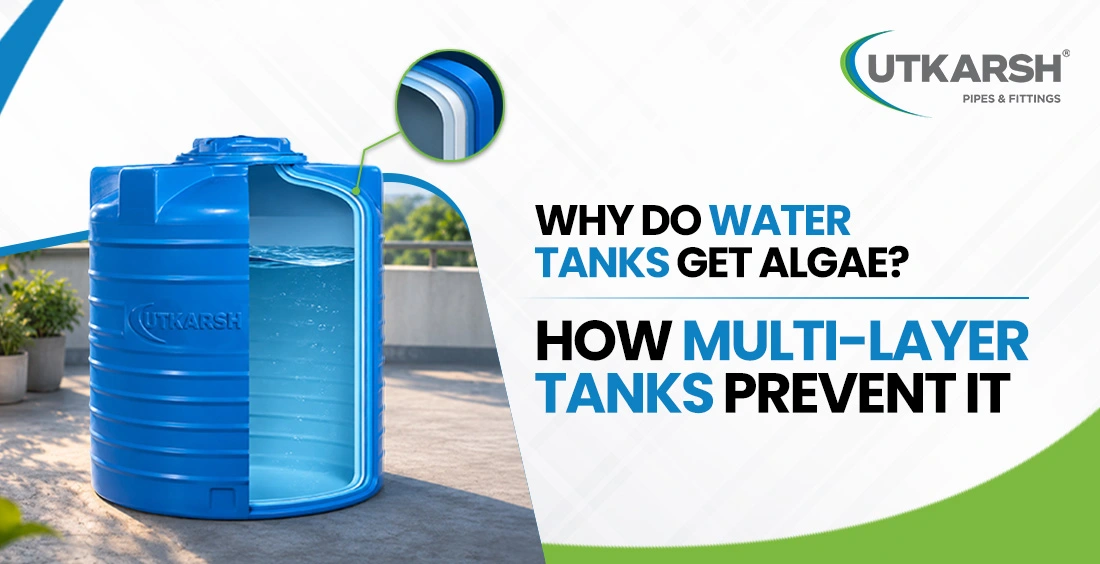
A multi-layer water tank is built by rotational moulding several layers of polyethylene into a single wall. Each layer has its own role, and together they tackle the root causes of algae, fungus and bacterial growth.
While the exact construction varies by manufacturer, a well-made multi-layer tank typically works like this.
Outer Layer: UV Protection
The outermost layer faces the sun, rain and dust. It is UV-stabilised so the tank does not become brittle, fade or crack after years on a rooftop. A tank that stays structurally sound is less likely to develop the hairline cracks that let light and dirt in.
Middle Layer(s): Blocking Light
The middle layer is usually the key to anti-algae performance. It is designed to stop sunlight from reaching the water inside. With no light, algae has no way to photosynthesise, so it cannot multiply, no matter how warm the weather gets. Because this layer does the light-blocking, a multi-layer tank stays opaque even when its outer colour is white. In 4-layer tanks, an additional layer adds wall strength and further improves protection.
Inner Layer: Food-Grade and Antimicrobial
The innermost layer is the only surface your water touches. In a good tank, it is made of 100% virgin, food-grade polyethylene so it does not affect taste or safety. When this layer includes antimicrobial protection, such as Microban, it resists the growth of bacteria, fungus and algae on the surface. A smooth inner surface also makes cleaning easier because there are fewer rough spots for biofilm to cling to.
Insulated Foam Layer: Keeping Water Cooler
Some premium tanks add an insulated foam layer. This limits how much heat reaches the stored water, which slows microbial growth and keeps the water more comfortable to use in peak summer.
Lid and Body Design
The wall construction works best alongside a few design features. A threaded lid that screws shut keeps out light, dust, birds and insects far better than a loose cap. A strong, well-shaped body also keeps the tank from deforming over time, which protects the lid seal and the overall structure.
ALSO READ: How Six-Shoulder Water Tank Design Enhances Compressive Strength
Single-Layer vs Multi-Layer Tanks: A Quick Comparison
| Feature | Single-Layer Tank | Multi-Layer Tank |
|---|---|---|
| Light blocking | Limited, as thin walls can let light through | Dedicated light-blocking layer |
| Algae resistance | Low | High |
| Inner surface hygiene | Depends on material | Food-grade, often with antimicrobial protection |
| UV resistance | Basic | UV-stabilised outer layer |
| Heat control | Minimal | Better, especially with an insulated foam layer |
| Wall strength | Lower | Higher, especially in 4-layer tanks |
| Cleaning frequency | Higher | Lower, though routine cleaning is still needed |
3-Layer or 4-Layer: Which Anti-Algae Water Tank Do You Need?
Both 3-layer and 4-layer tanks are effective as an anti algae water tank when they are well made. The right choice depends on your location, sun exposure and budget.
- 3-layer tanks are a strong everyday choice for most homes. They offer UV protection, light blocking and a hygienic inner layer.
- 4-layer tanks add extra wall strength and protection, which suits rooftops with long hours of direct sun.
- 4-layer insulated foam tanks are the best fit for regions with high temperatures or big temperature swings, since the foam limits heat gain and keeps stored water cooler.
How to Prevent Algae in a Water Tank: Practical Steps
A good tank does most of the work, but a few simple habits make a big difference. Here is how to prevent algae in a water tank at home:
- Keep the lid tightly closed at all times. Check that it sits evenly and has no cracks.
- Install the tank in a shaded spot where possible. If that is not practical, choose a tank with strong light-blocking and insulation.
- Screen the vent and overflow pipes with fine mesh to keep out insects, leaves and dust.
- Use a filter on the inlet if your source is borewell water or carries visible sediment.
- Size the tank to your daily needs so water turns over regularly instead of standing for long.
- Clean the tank every six months, and more often if the water source is dirty or the tank feeds a business or institution.
- Use food-grade pipes and fittings on the inlet and outlet so contamination is not reintroduced after the tank.
- Inspect regularly for cracks, discolouration and loose fittings, and fix problems early.
How to Clean a Tank That Already Has Algae
If your tank already shows green growth or fungus, follow these steps:
- Step 1: Drain the tank completely through the outlet or washout.
- Step 2: Scrub the inner walls and base with a soft brush or sponge and mild detergent. Avoid wire brushes or sharp tools, which scratch the surface and give biofilm a place to hold.
- Step 3: Rinse thoroughly to remove loosened algae, sediment and detergent.
- Step 4: Disinfect with a suitable chlorine solution, following the product label or the advice of a professional tank cleaning service. Let it stand for the recommended time.
- Step 5: Rinse again until no chemical smell remains.
- Step 6: Check the lid, vent and overflow before refilling so the cause of the algae is addressed too.
If algae keeps coming back within weeks of cleaning, the tank itself is usually letting in light. In that case, replacing it with a multi-layer tank is the more lasting solution.
ALSO READ: What Are the Maintenance Tips for Long-Lasting Water Storage Tanks?
Best Water Tank to Prevent Algae: What to Look For
When you are shopping for the best water tank to prevent algae, check for these features:
- Multi-layer construction (3-layer or 4-layer) with a dedicated light-blocking layer
- 100% virgin, food-grade polyethylene for safe drinking water
- Antimicrobial protection on the inner layer against bacteria, fungus and algae
- Full UV stabilisation for long outdoor life
- A threaded lid that seals properly
- Testing to IS 12701:1996, the Bureau of Indian Standards specification for rotational moulded polyethylene water storage tanks
- A meaningful warranty that reflects the manufacturer’s confidence in the product
For a broader buying checklist, read our guide on how to choose the right water storage tank for home or industrial use.
Utkarsh Water Storage Tanks: Built to Keep Algae Out
At Utkarsh Pipes and Fittings, our water storage tanks are designed around the very conditions that cause algae, fungus and bacterial growth. Every tank is made from 100% virgin, food-grade polyethylene and is 100% UV protected, with resistance to fungus, microbes, algae and corrosion.
The range includes:
- IS (2-Layer): Built to IS 12701:1996 as the base option in the range.
- Ujjal (3-Layer): Microban antimicrobial protection for everyday household use.
- U-Safe (4-Layer): Microban antimicrobial protection with added wall strength.
- U-Safe+ (4-Layer with Insulated Foam): Microban antimicrobial protection plus a foam layer for temperature regulation, ideal for very hot regions.
Each tank features a threaded lid, a multi-ribbed wall and a six-shoulder design for compressive strength. They come in 500, 750 and 1000 litre capacities, in Aqua Green, True Blue and Brilliant White, with 10% extra storage over the rated volume and a 10-year warranty from the date of installation.
Not sure which capacity suits your home? Our guide on how to calculate the right water tank capacity for your house can help.
Conclusion
Algae in a water tank comes from light, warmth, nutrients and time coming together inside your tank. Regular cleaning keeps the problem in check, but the lasting fix is a tank that keeps light out and resists microbial growth from the inside.
A well-built multi-layer tank, paired with a tight lid, a shaded location and a simple cleaning routine, gives your family clean, fresh water all year round. If your current tank keeps turning green, it may be time to upgrade to one built for Indian conditions.
Frequently Asked Questions
Why does algae grow in a water tank?
Algae grows in a water tank when sunlight, warmth and nutrients are present together. Light passing through a thin or single-layer tank wall, or through a loose lid, allows algae spores to photosynthesise and multiply. Warm rooftop temperatures, stagnant water and debris speed up the growth.
Is green algae in a water tank harmful?
Most common green algae are not toxic on their own, but they are a sign of poor water hygiene. Algae traps sediment and supports bacteria and biofilm, which can cause stomach infections, bad odour and skin irritation. Some blue-green algae can also release toxins, so a tank with algae should be cleaned promptly.
How can I prevent algae in my water tank?
To prevent algae in a water tank, keep light out by using an opaque multi-layer tank with a tight threaded lid. Place the tank in shade where possible, screen the vent and overflow pipes, filter the inlet water, and clean the tank every six months.
What is a multi-layer water tank?
A multi-layer water tank is a plastic tank whose wall is made of two or more bonded layers of polyethylene. Typically, the outer layer gives UV protection, the middle layer blocks sunlight to stop algae, and the inner layer is food-grade, often with antimicrobial protection. Some tanks also add an insulated foam layer.
Which water tank is best to prevent algae?
The best water tank to prevent algae is a 3-layer or 4-layer tank made of 100% virgin food-grade polyethylene, with a light-blocking layer, antimicrobial inner layer, full UV protection and a threaded lid. For very hot regions, a 4-layer tank with an insulated foam layer offers added protection.
What causes fungus in a water tank?
Water tank fungus grows in damp, poorly ventilated and dirty areas, usually near the lid, the waterline or fittings. Unlike algae, fungus does not need light. A loose lid, trapped moisture and infrequent cleaning are the most common causes. An antimicrobial inner layer and regular cleaning help prevent it.
How often should a water tank be cleaned to stop algae?
A household water tank should be cleaned at least once every six months. Clean it more often if the water source carries sediment, if the tank is used for a business or institution, or if you notice a green tint, slime or bad smell.
Can algae grow in a multi-layer water tank?
A good multi-layer tank blocks light, so algae growth inside is greatly reduced. However, algae can still form if the lid is left open, cracked or poorly fitted, or if dirt builds up over time. Keeping the lid sealed and following a regular cleaning routine keeps a multi-layer tank algae-free.