

The Key Differences Between Monopole and Transmission Tower Explained
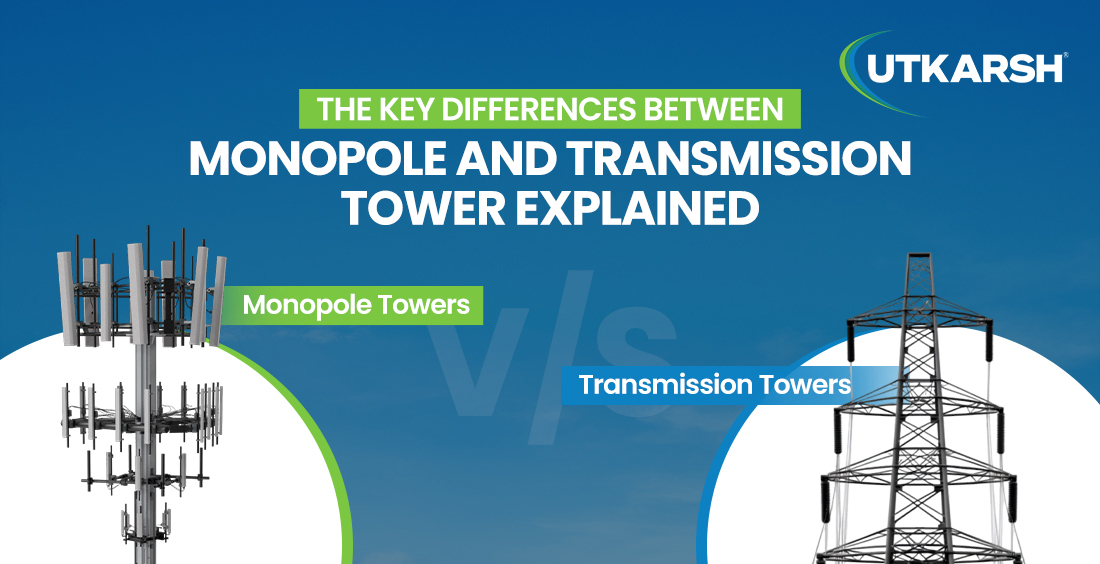
Modern power and telecommunication networks require infrastructure that can provide reliable support while meeting the structural and space requirements of different locations. Monopole transmission towers and conventional transmission towers are two important types of structures used across power, telecom, and utility infrastructure.
Although both are designed to support electrical or communication equipment, their structural design, load-bearing capacity, land requirements, installation methods, and applications are different.
A monopole generally consists of a single tubular steel shaft, while a conventional transmission tower is typically a lattice structure assembled from multiple steel members. The choice between them depends on factors such as voltage level, equipment load, right-of-way availability, terrain, wind conditions, and project requirements.
This guide explains the key differences between monopoles and transmission towers and the factors to consider when selecting the right structure.
What is a Monopole Tower?
A monopole is a single-column structure, generally manufactured using tubular or polygonal steel sections. Depending on its design, it can support telecommunications equipment, distribution lines, or other utility infrastructure.
A monopole transmission tower is particularly useful in locations where available land is limited. Its narrow footprint makes it suitable for urban, suburban, roadside, and other space-constrained environments.
Key Features of Monopole Towers
- Single tubular or polygonal steel structure
- Small foundation footprint compared with many lattice structures
- Suitable for space-constrained locations
- Relatively streamlined installation
- Lower visual profile in certain applications
- Can be designed for different equipment and loading requirements
- Suitable for selected power distribution and telecom applications
Monopoles are not limited to a single application. Their design and load capacity are determined according to the intended use, environmental conditions, and applicable engineering standards.
What is a Transmission Tower?
A transmission tower is a structural framework used primarily to support overhead electrical conductors and associated equipment. Conventional power transmission towers are generally constructed as lattice structures using steel angles or other structural members.
They are designed to carry significant mechanical loads while maintaining the required clearances between conductors, the tower, and the ground.
Transmission towers are commonly used in high-voltage power transmission networks where long-distance electricity transmission requires robust structural support.
Key Features of Transmission Towers
- Lattice steel framework
- High load-bearing capacity
- Suitable for high-voltage transmission lines
- Designed for long-distance power transmission
- Capable of supporting multiple conductors and earth wires
- Engineered to withstand wind, conductor, and other environmental loads
- Available in different configurations based on voltage and line requirements
Monopole vs Transmission Tower: Key Differences
While both structures provide support for infrastructure networks, they differ significantly in design and application.
| Feature | Monopole Tower | Transmission Tower |
|---|---|---|
| Structure | Single tubular or polygonal shaft | Usually a lattice framework |
| Footprint | Relatively compact | Generally larger |
| Typical applications | Telecom, distribution, and selected utility applications | High-voltage power transmission |
| Land requirement | Lower | Higher |
| Installation | Often comparatively straightforward | Requires assembly and erection of multiple structural members |
| Load capacity | Depends on design and application | Generally suitable for high electrical and structural loads |
| Visual profile | Narrow and streamlined | Wider lattice framework |
| Maintenance | Fewer structural members to inspect | Requires inspection of multiple members and connections |
| Design flexibility | Suitable for space-constrained installations | Available in multiple tower configurations for transmission networks |
It is important to note that neither structure is universally better. The appropriate solution depends on the project's technical and environmental requirements.
Monopole Transmission Tower: Applications
The compact design of monopoles makes them suitable for locations where space availability is a major consideration.
Common applications include:
Telecom Infrastructure
Monopoles can support antennas and other communication equipment used for mobile networks, wireless connectivity, and broadcasting.
Urban Utility Infrastructure
In selected power distribution applications, monopoles can provide electrical support while occupying less ground space than conventional lattice structures.
Roadside Installations
Their compact footprint makes them suitable for utility infrastructure along roads and other locations with limited right-of-way.
Commercial and Industrial Areas
Monopoles can be considered for sites where a narrow structural footprint and controlled visual profile are important.
Get Insights On: How Monopole Transmission Towers Help Reduce Land Usage in Power Projects
Transmission Tower Applications
Conventional transmission towers are primarily associated with electrical power transmission and are used extensively across utility networks.
High-Voltage Power Transmission
Transmission towers support overhead conductors that carry electricity over long distances between generating stations, substations, and distribution networks.
Power Grid Infrastructure
They form an important part of interconnected electricity networks and help maintain the required conductor clearances.
Substation Infrastructure
Specialised steel structures are also used within substations to support electrical equipment, busbars, conductors, and related systems.
Factors to Consider When Choosing Between a Monopole and Transmission Tower
The selection of a tower should be based on engineering requirements rather than appearance or footprint alone.
1. Load Requirements
The structure must safely support the weight of conductors, antennas, cables, accessories, and other equipment, along with environmental loads.
2. Voltage and Electrical Configuration
For power projects, the required voltage level, conductor arrangement, span length, and electrical clearances influence the type and configuration of the supporting structure.
3. Available Land
A monopole can be advantageous where land or right-of-way is restricted. Transmission towers generally require more space for their foundations and overall configuration.
4. Wind and Environmental Conditions
Tower designs must account for wind pressure, temperature variations, seismic conditions, terrain, and other site-specific factors.
5. Installation Requirements
The accessibility of the site, transportation limitations, erection equipment, and project schedule should also be considered during tower selection.
6. Maintenance Requirements
The number of structural components, connections, coatings, and equipment involved can influence inspection and maintenance requirements over the tower's service life.
Types of Tower Solutions
Infrastructure projects may require different tower and structural solutions depending on their purpose.
Transmission Towers
Lattice structures designed primarily for overhead high-voltage power transmission.
Telecom Towers
Structures designed to support antennas and communication equipment for mobile networks, wireless services, and broadcasting.
Substation Structures
Steel frameworks used to support electrical equipment, busbars, conductors, and other components within substations.
Monopoles
Single-pole structures used for selected telecom, utility, and power distribution applications where a compact footprint is beneficial.
Power Distribution Poles
Structures used to support electrical distribution networks serving residential, commercial, and industrial areas.
Why Quality Matters in Transmission and Monopole Structures
Tower infrastructure must remain structurally reliable throughout its operational life. Manufacturing quality, steel grade, galvanisation, fabrication accuracy, welding quality, and structural design all influence performance.
Experienced transmission tower manufacturers typically focus on:
- Quality-controlled raw materials
- Accurate fabrication
- Structural design and engineering
- Welding and dimensional inspections
- Galvanisation and corrosion protection
- Load and quality testing
- Compliance with applicable standards
- Proper packaging and transportation
Hot-dip galvanisation is commonly used to protect steel structures against corrosion, particularly when towers are exposed to outdoor and demanding environmental conditions.
Choosing the Right Transmission Tower Manufacturer
Selecting an experienced manufacturer is essential for projects involving power transmission and telecom infrastructure.
Before finalising a supplier, consider:
- Manufacturing capabilities
- Engineering and design expertise
- Production capacity
- Quality-control systems
- Applicable certifications and approvals
- Raw material sourcing
- Galvanisation facilities
- Testing capabilities
- Installation and technical support
- Experience with similar projects
A reliable manufacturer should be able to customise tower designs according to project-specific loading, environmental, electrical, and dimensional requirements.
Why Choose an Experienced Infrastructure Company?
Large-scale tower projects require coordination between design, material procurement, fabrication, galvanisation, logistics, and installation. Working with an experienced best infrastructure company in India like Utkarsh India can help streamline these stages and maintain quality throughout the project.
Utkarsh India provides transmission, telecom, monopole, and related steel infrastructure solutions for different project requirements. The company states that it has more than four decades of industry experience and supplies tower solutions to power and telecom infrastructure projects.
Its stated raw material sourcing includes established suppliers and approved sources such as SAIL, Tata, RINL, Jindal, Hindustan Zinc, PGCIL-approved sources, CORE-approved sources, and BIS-approved sources.
For current product specifications, approvals, and project capabilities, the latest information should be confirmed directly with the manufacturer.
Conclusion
Monopoles and conventional transmission towers serve different infrastructure requirements. A monopole transmission tower offers a compact structural solution that can be particularly useful in space-constrained locations and selected telecom or utility applications. Conventional transmission towers, meanwhile, are widely used for high-voltage, long-distance power transmission because of their structural configuration and high load-bearing capabilities.
The right choice depends on factors such as electrical requirements, structural loads, land availability, environmental conditions, installation constraints, and project objectives.
By working with experienced transmission tower manufacturers, utilities, telecom operators, contractors, and infrastructure developers can select and deploy tower structures that meet the required safety, performance, and durability standards.
Frequently Asked Questions
1. What is the main difference between a monopole and a transmission tower?
A monopole is generally a single tubular or polygonal steel structure with a compact footprint, while a conventional transmission tower is typically a lattice framework made from multiple steel members. Monopoles are commonly used for telecom and selected utility applications, whereas lattice transmission towers are widely used for high-voltage power transmission.
2. When is a monopole transmission tower preferred?
A monopole transmission tower may be preferred when space is limited, a narrow structural footprint is required, or the project involves telecom equipment or selected power distribution applications. The final choice depends on structural loads, electrical requirements, site conditions, and applicable standards.
3. Are transmission towers stronger than monopoles?
Neither type is inherently stronger in every application. Strength and load capacity depend on the structural design, material grade, dimensions, foundation, and project-specific loading requirements. Lattice transmission towers are commonly designed for high-voltage transmission loads, while monopoles can also be engineered for substantial loads when appropriately designed.
4. What should I consider when selecting a transmission tower manufacturer?
Consider the manufacturer's engineering capabilities, fabrication capacity, raw material quality, galvanisation facilities, testing procedures, applicable standards and approvals, project experience, and technical support. A manufacturer with end-to-end capabilities can help ensure consistent quality from design through installation.