

Inside MS Pipe Manufacturing: How Steel is Turned into Durable Pipes
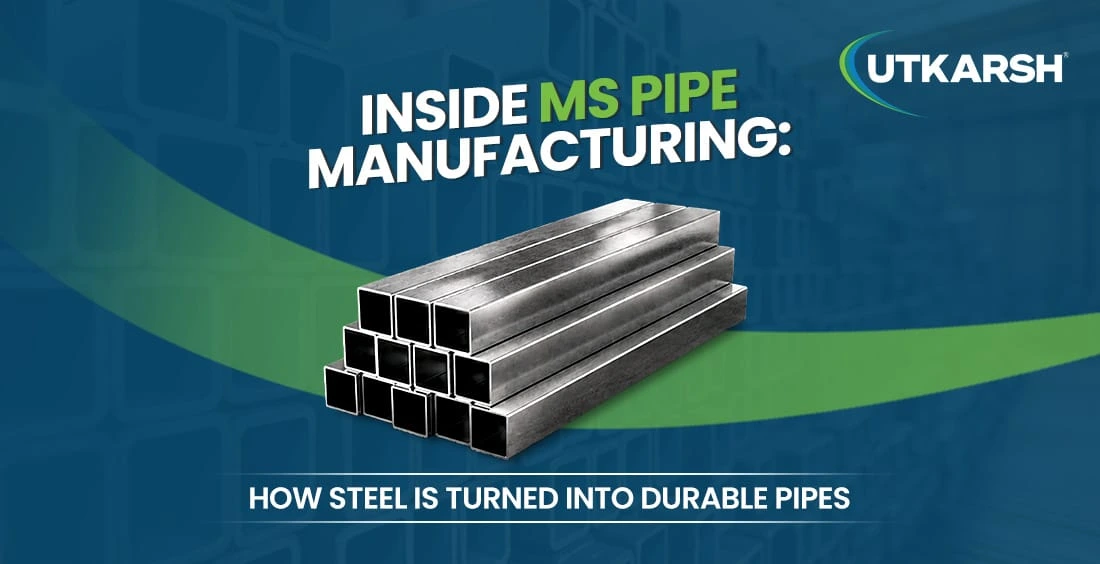
Mild Steel (MS) pipes are among the most widely used steel products in modern infrastructure, construction, engineering, and industrial applications. From structural frameworks and water distribution systems to HVAC installations and industrial pipelines, MS pipes form the backbone of countless projects.
However, what makes these pipes strong, durable, and reliable? The answer lies in a highly controlled MS pipe manufacturing process that transforms raw steel into precision-engineered pipes capable of withstanding demanding operating conditions.
In this article, we explore how MS pipes are manufactured, the raw materials involved, the stages of production, and the quality measures that ensure long-term performance.
Also Read: Why MS Square Pipes Are Changing the Way India Builds Its Infrastructure
Understanding MS Pipes
MS (Mild Steel) pipes are manufactured using low-carbon steel, making them highly versatile, weldable, and cost-effective. Their balanced mechanical properties make them suitable for structural, industrial, agricultural, and engineering applications.
Common types include:
- Round MS pipes
- Mild steel square pipe
- MS rectangular pipe
- ERW (Electric Resistance Welded) pipes
- Black steel pipes
- Galvanized steel pipes
Their popularity stems from their excellent strength-to-weight ratio, ease of fabrication, and durability.
Raw Materials Used in MS Pipe Manufacturing
The quality of an MS pipe begins with the quality of its raw materials. The manufacturing process involves carefully selected materials that meet stringent industry standards.
1. Iron Ore
Iron ore serves as the fundamental raw material for steel production. Extracted from mines and processed through various metallurgical operations, iron ore provides the iron required for manufacturing steel.
The purity and quality of iron ore directly influence the strength and performance of the final steel product.
2. Carbon Steel
Carbon steel forms the primary base material for MS pipes. It contains controlled amounts of carbon that contribute to:
- High tensile strength
- Good ductility
- Excellent weldability
- Ease of fabrication
The low-carbon composition of mild steel makes it particularly suitable for pipe manufacturing.
3. Alloying Elements
To enhance performance characteristics, manufacturers often introduce alloying elements such as:
- Manganese
- Nickel
- Chromium
- Molybdenum
These elements improve:
- Corrosion resistance
- Hardness
- Strength
- Heat resistance
- Wear resistance
The precise composition depends on the intended application of the pipe.
The MS Pipe Manufacturing Process: Step-by-Step
Step 1: Selection of Hot Rolled Steel Coils
The process begins with high-quality Hot Rolled (H.R.) steel coils or H.R. sections. These coils act as the primary raw material for manufacturing steel tubes and pipes. High-grade steel ensures consistent quality throughout production.
Manufacturers source steel from reputed suppliers to maintain strength, reliability, and dimensional consistency. Utkarsh India sources raw materials from leading steel producers such as TATA and SAIL to ensure superior product quality.
Step 2: Production Planning
Before actual production begins, detailed planning is conducted to optimize:
- Material utilization
- Production efficiency
- Resource allocation
- Product specifications
This stage ensures smooth manufacturing operations and compliance with customer requirements.
Step 3: Slitting and Shearing
The steel coil is passed through slitting lines where it is cut into strips of predetermined widths.
This stage ensures:
- Uniform dimensions
- Accurate pipe diameter
- Consistent wall thickness
For larger sections, shearing operations are used to prepare the steel for further processing.
Step 4: Pipe Forming
This is where flat steel begins transforming into a pipe.
The steel strip passes through a series of rollers that gradually bend and shape it into a cylindrical, square, or rectangular profile.
Depending on the end product, manufacturers can create:
- Round pipes
- Mild steel square pipe
- Rectangular hollow sections
- Structural tubes
The forming process must maintain precise dimensional tolerances for consistent product quality.
Step 5: Welding the Pipe
Once the strip reaches the desired shape, the open edges are welded together.
Most modern MS pipes are manufactured using Electric Resistance Welding (ERW), where electrical current generates heat at the edges, creating a strong and uniform weld. This process produces pipes with excellent structural integrity and smooth surface finishes.
The welding stage is crucial because it determines:
- Joint strength
- Pressure resistance
- Overall durability
Step 6: Sizing and Calibration
After welding, pipes pass through sizing mills that refine:
- Outer diameter
- Wall thickness
- Straightness
- Dimensional accuracy
This stage ensures every pipe meets specified standards and project requirements.
Step 7: Cutting and Finishing Operations
The continuous pipe is cut into standard or customized lengths.
Additional operations may include:
- Bending
- Stamping
- Notching
- Embossing
- End forming
- Hill grinding
- Base plate fitting
These processes help prepare the pipes for specific industrial and structural applications.
Step 8: Non-Destructive Testing (NDT)
One of the most important stages in the ms pipe manufacturing process is quality testing.
Non-Destructive Testing (NDT) is conducted to identify any defects without damaging the pipe. Tests evaluate:
- Weld quality
- Structural integrity
- Material consistency
- Surface defects
This ensures the pipes meet stringent safety and performance requirements.
Step 9: Surface Protection
To improve durability and corrosion resistance, pipes may undergo:
- Varnishing
- Painting
- Protective coating
- Galvanization
These treatments protect the pipe from environmental exposure and extend its service life significantly.
Step 10: Final Inspection
Before dispatch, every pipe undergoes a comprehensive inspection.
Manufacturers verify:
- Dimensions
- Surface finish
- Weld integrity
- Mechanical properties
- Compliance with standards
Only products meeting all quality criteria are approved for shipment.
Quality Standards Followed by Leading MS Pipe Manufacturers
Reliable MS pipe Manufacturing Standards for Durability from the Leading Manufacturer adhere to national and international standards to ensure quality, safety, and performance.
- IS 1239 – Steel Tubes for Water, Air, Steam, and Gas Applications
- IS 3589 – Steel Pipes for Water and Sewage Transmission
- IS 1161 – Structural Steel Tubes
- IS 4923 – Hollow Steel Sections for Structural Applications
- ASTM A53 – Standard Specification for Steel Pipe
- ASTM A500 – Cold-Formed Structural Tubing
- EN 10219 – European Standard for Structural Hollow Sections
- ISO Standards – International Quality Management Systems
Compliance with these standards guarantees safety, performance, and long-term reliability across diverse applications.
Applications of MS Pipes
Construction and Infrastructure
MS pipes play a crucial role in modern construction projects due to their high load-bearing capacity and structural stability.
Structural Frameworks
MS pipes are widely used for constructing building frameworks, industrial sheds, warehouses, commercial complexes, and prefabricated structures.
Scaffolding
Construction sites frequently use MS pipes for scaffolding systems because they provide necessary support and safety.
Bridges
Steel pipes are used in bridge construction for support members, railings, and reinforcements.
Building Supports
Columns, beams, handrails, staircases, and support structures often incorporate MS pipes.
Industrial Piping
Water Transportation
MS pipes are used in municipal water supply networks and irrigation systems.
Gas Pipelines
Used for transporting compressed air and industrial gases.
Process Piping Systems
Used in manufacturing plants for conveying liquids and chemicals.
Mechanical Systems
HVAC Systems
Used in heating, ventilation, and air conditioning installations.
Machinery Fabrication
Used in machine frames, conveyors, and industrial equipment.
Equipment Manufacturing
Used in storage systems and material handling equipment.
Agriculture
Irrigation Networks
Used for efficient water distribution in farms.
Farm Infrastructure
Used in fencing, greenhouses, and storage sheds.
Automotive and Transportation
Vehicle Structures
Used in chassis components and protective frames.
Transportation Infrastructure
Used in bus shelters, railway structures, and barriers.
Conclusion
The MS pipe manufacturing process transforms raw steel into durable, high-performance pipes through precision engineering, welding, testing, and quality assurance. By combining superior raw materials with advanced manufacturing capabilities, Utkarsh India delivers reliable MS pipe solutions designed to meet the evolving demands of modern infrastructure and industrial applications.
As a leading MS pipe manufacturing company, Utkarsh India Limited manufactures high-quality MS pipes using advanced tube mill technology, premium-grade steel, and stringent quality control processes.
Partner with one of India's trusted ms pipe manufacturers and discover high-quality, precision-engineered pipe solutions from Utkarsh India.
Looking for high-quality MS pipes for your next project? Explore Utkarsh India's durable and precision-engineered pipe solutions today.