

How Fabrication Quality Impacts Crash Barrier Performance
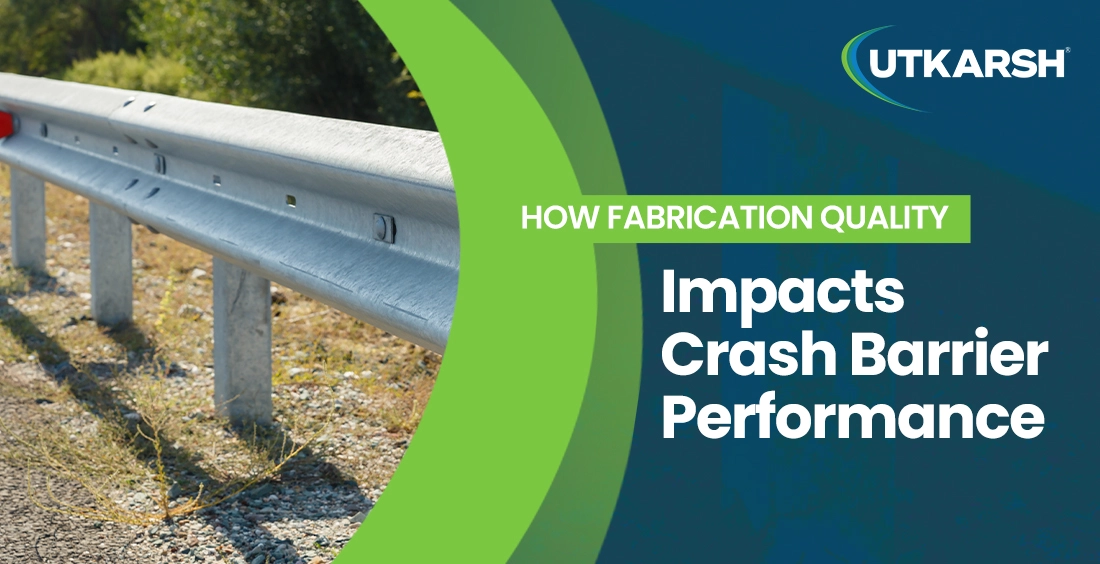
Quality defines safety on every road, a compliance framework set by iRAP, MoRTH, NHAI
- iRAP – International Road Assessment Programme
A global program that assesses road safety and helps reduce road crash risks through star ratings and safer road design insights. - MoRTH – Ministry of Road Transport and Highways
The central government ministry in India responsible for road transport policies, highway development, and safety regulations. - NHAI – National Highways Authority of India
An autonomous agency under MoRTH that develops, maintains, and manages India’s national highway network.
These standards and international road safety bodies, even minor deviations in fabrication quality can significantly impact crash barrier performance during real-world collisions. Studies and field inspections across highways have consistently shown that improperly fabricated road safety barriers are far more likely to fail under impact - leading to higher injury severity.
Crash barriers are not just steel structures placed along roads - they are engineered life-saving systems designed to absorb impact, redirect vehicles, and reduce fatalities. In high-speed corridors and accident-prone zones, the reliability of road safety crash barriers can mean the difference between a near miss and a fatal accident.
For infrastructure developers, EPC contractors, and government authorities, this makes fabrication quality a critical factor - not just for meeting crash barrier specification standards, but for ensuring long-term safety outcomes across India’s expanding road safety infrastructure.
Key Elements of Fabrication That Influence Crash Barrier Performance
1. High-Grade Steel Selection
The performance of road safety barriers begins with the quality of raw materials. High-tensile steel ensures:
- Controlled deformation during impact
- Effective energy absorption
- Resistance to cracking under stress
Precision in chemical composition and mechanical properties ensures that barriers behave predictably during collisions.
2. Precision Roll Forming Technology
Modern road safety crash barriers, including W-Beam and Thrie-Beam systems, rely on accurate profiling.
Utkarsh India’s manufacturing process includes:
- Automated roll forming for uniform geometry
- Consistent beam thickness and curvature
- Tight dimensional tolerances for seamless installation
This precision ensures that the barrier distributes impact forces evenly, reducing the risk of structural failure.
3. Advanced Hot-Dip Galvanization
Durability is essential for any road safety infrastructure exposed to weather, pollution, and varying terrains.
Fabrication quality includes:
- Uniform zinc coating through hot-dip galvanization
- Long-term corrosion resistance
- Compliance with IRC and IS standards
This prevents early degradation, ensuring the barrier performs effectively even after years of exposure.
4. Accurate Punching and Component Alignment
Every bolt, spacer, and post in a crash barrier system must align perfectly.
Fabrication precision ensures:
- Correct hole positioning
- Proper load transfer during impact
- Strong joint integrity
Even small inaccuracies can weaken the overall system and compromise crash performance.
5. Stringent Quality Inspection Protocols
Top crash barrier manufacturers implement multi-stage quality checks, including:
- Dimensional verification
- Coating thickness testing
- Mechanical strength assessment
This ensures that every barrier installed on-site meets required crash barrier specification standards.
6. Mechanical Strength Testing
Rigorous testing of:
- Yield Strength (YSt)
- Ultimate Tensile Strength (UTS)
- Elongation Percentage (E%)
This ensures that the material can deform without breaking, allowing effective energy absorption and minimizing injury risks.
Also Read: How Crash Barriers Reduce the Severity of Accidents: A Technical Breakdown
Understanding Real Impact Outcomes From Fabrication to Field Safety
Fabrication quality does not just influence product durability - it directly affects how barriers perform during accidents.
This is where Fatal and Serious Injury (FSI) Estimates become relevant.
Understanding FSI Estimates
Fatal and Serious Injury (FSI) Estimates are data-driven assessments used to evaluate how road conditions, traffic flow, and crash history influence the likelihood of severe accidents. These estimates help quantify the probability of fatalities and serious injuries across specific road segments, enabling authorities to make informed decisions and prioritize investments in road safety infrastructure.
When aligned with crash barrier design and fabrication, FSI becomes a powerful indicator of real-world performance. High-quality fabrication of road safety barriers plays a crucial role in reducing crash severity by ensuring effective energy absorption and vehicle redirection. Properly manufactured road safety crash barriers also contribute to improved Star Ratings and overall safer road designs, ultimately leading to lower FSI outcomes.
FSI estimations consider multiple road users, including:
- Vehicle occupants
- Motorcyclists
- Bicyclists
- Pedestrians
Using advanced tools like ViDA, these insights further support:
- Road safety inspections
- Impact assessments
- Infrastructure investment planning
Key Insight: Even the most advanced design and planning cannot significantly reduce FSI rates if the fabrication quality of safety barriers does not meet the required crash barrier specification standards.
Conclusion
In modern road safety infrastructure, performance is not defined by design alone - it is built through precision fabrication at every stage.
As one of India’s trusted crash barrier manufacturers, Utkarsh India Limited integrates advanced manufacturing processes, strict quality control, and in-house galvanization to deliver high-performance road safety barriers.
With four decades of engineering expertise and continuous technological upgradation, Utkarsh India ensures that every crash barrier is:
- Built to meet stringent crash barrier specification standards
- Designed for long-term durability
- Engineered to reduce real-world accident severity
For developers and authorities aiming to build safer roads, choosing the right fabrication partner is not just a technical decision - it is a commitment to saving lives.
FAQs
1. How does fabrication quality affect crash barrier performance?
High-quality fabrication ensures proper strength, alignment, and durability, allowing barriers to absorb impact and reduce accident severity effectively.
2. What standards are followed for crash barrier manufacturing in India?
Crash barriers are manufactured as per BIS IS and IRC standards, ensuring safety, durability, and compliance with national guidelines.
3. What is the role of galvanization in road safety barriers?
Galvanization protects barriers from corrosion, extending their lifespan and ensuring consistent performance in different environmental conditions.
4. How do FSI Estimates help in road safety planning?
FSI Estimates predict potential fatalities and serious injuries, helping authorities design safer roads and prioritize infrastructure improvements.