

Qualities You Should Look for when Choosing an HDPE Pipe Supplier
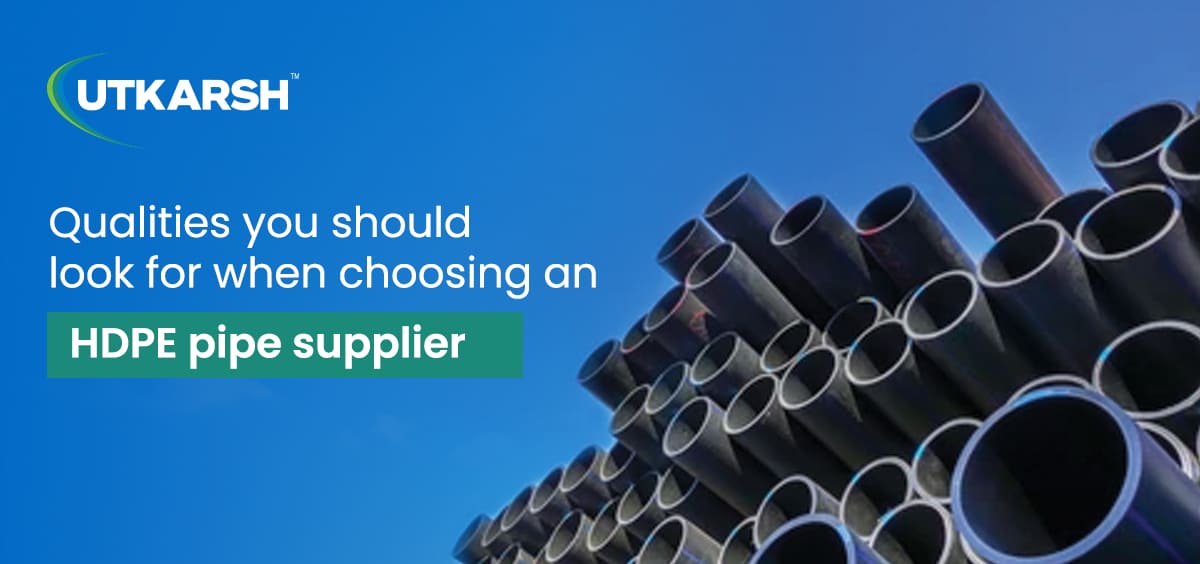
When choosing an HDPE pipe supplier, check five things first: a valid BIS licence under IS 4984, the PE grades and pressure ratings on offer, batch-wise test certificates, the manufacturer's production capacity, and its ability to deliver to your site on time. Price matters, but only once you are comparing pipes of the same grade, pressure rating and size.
Two coils of black HDPE pipe can look identical at a dealer's yard. The difference shows up later, as a split length, a failed joint or a line that cannot hold its rated pressure. What separates them is the polyethylene grade, the wall thickness, the raw material and the testing behind each batch. All of that depends on who made the pipe.
HDPE pipes are widely used for water supply, irrigation, sewerage and industrial lines because they resist corrosion and flex without cracking. You can read more about their uses and advantages. This guide is about assessing the supplier. If you are still deciding on the pipe specification itself (grade, PN rating, SDR or size), read our guide on factors to consider when looking for HDPE pipes.
Planning a water supply, irrigation or industrial pipeline? Get BIS-certified HDPE pipes in PE 63, PE 80 and PE 100, from 20 mm to 315 mm. Talk to our team →
1. Is the Supplier BIS Certified Under IS 4984?
IS 4984:2016 is the Indian Standard for polyethylene pipes for water supply. A licensed manufacturer prints the ISI mark on the pipe along with its CM/L licence number.
Do not rely on the mark alone. Ask for a copy of the licence and check it yourself: open the free BIS Care app, go to "Verify Licence Details" and enter the CM/L number. The app shows the licensee's name and address, licence validity and the product varieties covered. If the licence has expired, or the name does not match the company quoting you, walk away.
For projects that call for international standards, also ask whether the pipe conforms to ISO 4427 or EN 12201, the ISO and European standards for PE water pipes.
2. Does It Manufacture the Pipes or Only Trade Them?
A trader can only vouch for what someone else made. A manufacturer controls the full chain: which resin goes into the extruder, how the line is set and how each batch is tested before dispatch. Ask where the plant is, whether extrusion happens in-house, whether fittings are made in-house or bought in, and who signs off on quality control.
Utkarsh India manufactures its HDPE pipes at its own plastic extrusion plant in Gurap, West Bengal, on a 44,000 square metre site with 12,000 square metres of covered area. The company was the first in East India to set up an automated polymer plant and to manufacture fittings.
3. Does the Range Cover Your Grade, Pressure Rating and Size?
HDPE pipe grades are named after their minimum required strength (MRS). PE 63, PE 80 and PE 100 correspond to an MRS of 6.3, 8 and 10 MPa, the long-term strength of the material at 20°C over 50 years. A higher grade can carry the same pressure with a thinner wall, or a higher pressure with the same wall.
The PN rating is the pipe's nominal working pressure. PN 6, for example, means roughly 6 kgf/cm². A supplier with a narrow range may push what is in stock rather than what your project needs.
Utkarsh India's BIS-certified HDPE pipes are available in PE 63, PE 80 and PE 100, with pressure ratings from PN 2.5 to PN 16 and outer diameters from 20 mm to 315 mm.
4. Does It Test Every Batch and Share the Certificates?
Quality is the factor that matters most, because a pipe failure underground costs far more than the pipe itself. Under the BIS certification scheme for IS 4984, manufacturers test pipes from each production lot for:
- Dimensions and visual appearance
- Longitudinal reversion
- Carbon black content and dispersion (test method IS 2530)
- Melt flow rate (IS 2530)
- Density (IS 7328)
- Hydraulic characteristics (internal pressure tests)
Ask for the test certificate that matches the batch number printed on the pipes you receive.
Raw material deserves its own question. Ask which resin grade was used and whether the compound is virgin polyethylene. Reprocessed material from unknown sources is a common way to cut cost, and it can compromise long-term pressure performance.
Utkarsh India runs an in-house testing lab, and its Gurap facility holds ISO 9001:2015 management system certification. Its HDPE pipes are manufactured under BIS licence CM/L-0005817983 as per IS 4984:2016. Visit our quality and certifications page for details.
5. How Long Has It Been Extruding Polymer Pipes?
Company age is not the same as pipe experience. A firm with decades in another business may have started extrusion only recently. Ask how long the polymer division has been running and what volume it ships each year.
Utkarsh India brings over 40 years of experience across steel fabrication, galvanisation, plastic extrusion and moulding. Its polymer manufacturing capacity is 68,000 MT per annum.
6. Can It Show a Track Record on Projects Like Yours?
Ask for references from projects of a similar scale and type, such as government water supply schemes, irrigation networks or industrial lines. A good supplier will share client names and order details you can check.
For the Jal Jeevan Mission in West Bengal, Utkarsh India supplied 430 MT of PE 100 PN 6 HDPE pipes to Mackintosh Burn Ltd for work across Howrah, Hooghly and Medinipur. Read the full Jal Jeevan Mission case study.
7. Is the Price Transparent and Comparable?
HDPE pipe prices depend on the PE grade, PN rating, outer diameter (which sets wall thickness and the weight of resin per metre), order quantity and freight. Quotes come either per metre or per kg, so convert both to cost per metre for the same grade, PN and diameter before comparing. Check the weight per metre too. A pipe that weighs less than it should has a thinner wall than the standard requires.
A quote far below the market rate usually means a lower grade, a thinner wall or recycled material. Utkarsh India prices its HDPE pipes per metre, which makes project costing straightforward.
8. Can It Deliver to Your Site on Time?
Tight project schedules and remote sites make logistics as important as the pipe. Ask about lead times for your sizes, whether they are stocked or made to order, and how the supplier handles transport to your location. Smaller diameters are often supplied in coils, which reduces joints, while larger diameters come in straight lengths.
Utkarsh India supplies straight HDPE pipes in lengths of 6 to 9 metres. Its Gurap plant gives projects across Eastern India a shorter supply route, supported by a dealer network across the country.
What Technical Support Should a Supplier Provide?
HDPE is lighter and easier to handle than metal pipe, but jointing larger diameters still needs the right equipment and trained operators. The three common jointing methods are:
- Butt fusion: pipe ends are heated and pressed together with a butt fusion machine. It is widely used for larger diameters.
- Electrofusion: couplers with embedded heating wires are fused to the pipe. It suits tight spaces, repairs and branch connections.
- Compression fittings: mechanical fittings used on smaller diameters, with no heating required.
Ask whether the supplier provides matching fittings, guidance on jointing and laying, and a clear process for handling complaints after delivery. Utkarsh India offers after-sales support for its customers.
Questions to Ask Before You Place an Order
- Can you share a copy of your BIS licence under IS 4984?
- Can you provide the test certificate for this batch?
- Is the PE grade and PN rating printed on every pipe?
- What resin grade do you use, and is it virgin material?
- What is your minimum order quantity and lead time for my sizes?
- Do you supply matching fittings and support jointing on site?
Red Flags to Watch For
- No ISI mark, IS number or CM/L number printed on the pipe
- A price far below the market rate for the same grade and PN
- No batch test certificate, or a certificate that does not match the batch number
- A vague answer about where the resin comes from
- A licence that does not show up, or shows as expired, in the BIS Care app
HDPE Supplier Checklist at a Glance
| What to Check | Why It Matters | What Utkarsh India Offers |
|---|---|---|
| BIS licence | Confirms the pipe meets IS 4984 for water supply | IS 4984:2016, CM/L-0005817983 |
| Grades and pressure ratings | You get the specification your project needs, not what is in stock | PE 63 / 80 / 100, PN 2.5 to PN 16 |
| Size range | One supplier can cover service lines and mains | 20 mm to 315 mm OD |
| Manufacturing control | The maker controls resin, extrusion and testing | Own extrusion plant at Gurap, West Bengal |
| Capacity | Large orders ship on schedule | 68,000 MT per annum polymer capacity |
| Track record | Proof of performance on similar projects | 430 MT of PE 100 PN 6 pipes for Jal Jeevan Mission, West Bengal |
| Pricing basis | Makes quotes easy to compare | Per metre |
Looking for a Reliable HDPE Pipe Manufacturer?
Utkarsh India manufactures HDPE pipes for buried, surface and floating applications, across water supply, irrigation, sewerage, mining and industrial projects. As an HDPE pipe supplier and manufacturer, we offer:
- A polymer manufacturing capacity of 68,000 MT per annum
- BIS-certified pipes under IS 4984:2016, in PE 63, PE 80 and PE 100
- Pressure ratings from PN 2.5 to PN 16 and sizes from 20 mm to 315 mm
- Proven supply on government water projects, including 430 MT for the Jal Jeevan Mission in West Bengal
To discuss your project requirements, contact us.
Frequently Asked Questions
Which BIS standard applies to HDPE water pipes?
IS 4984:2016, the Indian Standard for polyethylene pipes for water supply. IS 4427 is often quoted by mistake; the correct international reference is ISO 4427.
What is the difference between PE 80 and PE 100?
PE 100 has a higher minimum required strength (10 MPa against 8 MPa for PE 80). For the same pressure rating, a PE 100 pipe can have a thinner wall, which gives a larger bore and lower weight per metre.
How do I verify a supplier's BIS licence?
Download the BIS Care app, open "Verify Licence Details" and enter the CM/L number printed on the pipe or shown on the licence copy. The app shows the licensee's name, validity and the products covered.
Should HDPE pipes be bought per metre or per kg?
Either works, as long as you compare like for like. Convert every quote to cost per metre for the same grade, PN rating and diameter, and check the weight per metre against the standard. Utkarsh India quotes per metre.
What is the typical life of an HDPE pipe?
Utkarsh India's HDPE pipes have a life expectancy of 50 to 100 years when installed correctly and operated within their rated pressure.